
South Korea has the widest housing price gap between big cities and small towns among OECD nations, according to a new report.
The OECD Regions and Cities at a Glance 2024 study found that home prices in Korea’s larger cities — those with a population over 1.5 million — are more than three times higher than in smaller cities with fewer than 100,000 residents.
At 211 percent, the gap in Korea is the widest among the 18 OECD countries analyzed, far larger than the 162 percent for the US and 116 percent for Hungary, which showed the second and third largest gaps respectively. Meanwhile, the UK (19.5 percent) and Poland (41.8 percent) show much narrower differences.
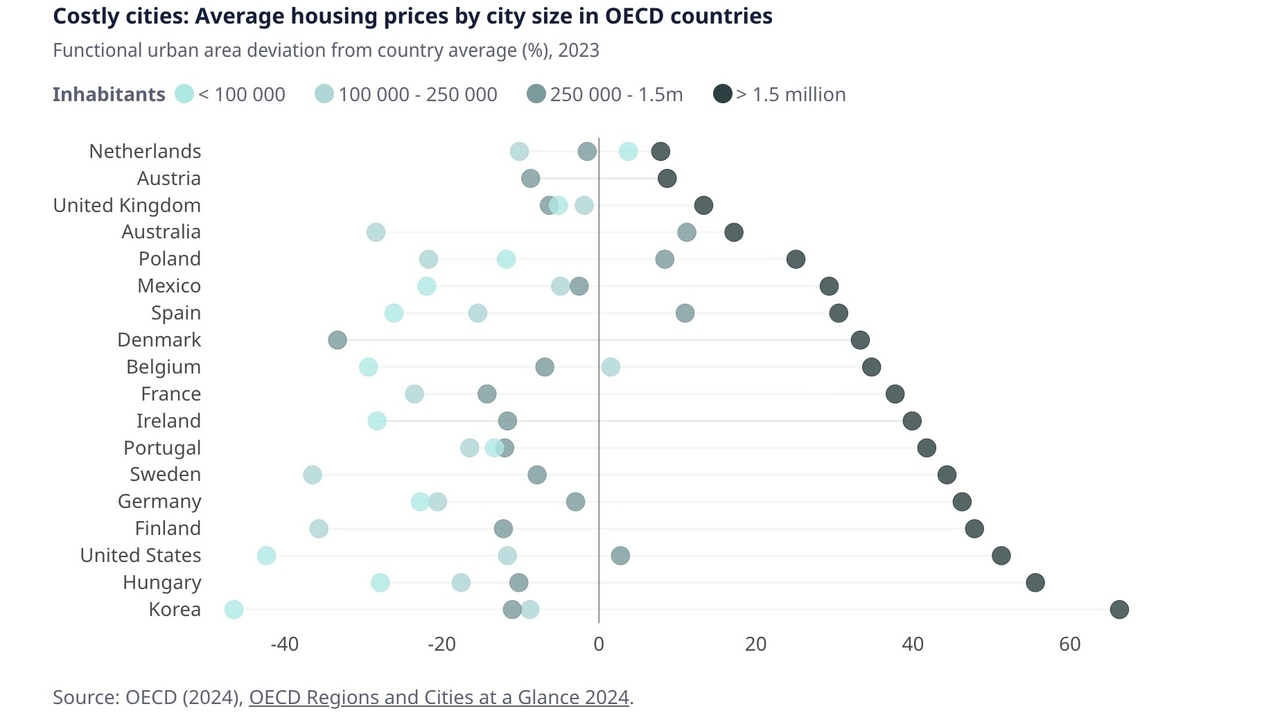
The report found that across member nations, home prices in metropolitan areas with over 1.5 million people rose by 68 percent from 2013 to 2023, while small-city prices increased by just 16 percent. On average, home prices in large OECD cities were 86 percent higher than in smaller ones.
South Korea, however, far exceeded this trend. Home prices in its large cities were 66.3 percent above the OECD average, while prices in small cities lagged 46.5 percent below.
Why is Korea's housing gap so extreme?
Real estate is one of the main ways Koreans build and store wealth. With demand concentrated in Seoul and surrounding areas, home prices in big cities keep rising while small towns struggle with population decline and economic stagnation.
According to Statistics Korea, the average homeowner had 720 million won ($500,000) in assets last year, with 79 percent tied up in real estate. Among the wealthiest 20 percent, property accounted for 77 percent of total assets. This heavy reliance on real estate has created a growing class of so-called "house poor," or people who own valuable homes but have little disposable income due to high mortgages.
Meanwhile, regional infrastructure gaps make things worse. The OECD measured public transportation accessibility, tracking how many destinations within an 8-kilometer radius of a city center could be reached within 30 minutes. In Daejeon, 65.2 percent of locations were accessible, while 68.1 percent were in Ulsan.
But in Gumi, North Gyeongsang Province, only 34.8 percent had comparable access. Fewer job opportunities and weaker infrastructure make these areas even less attractive, pushing more people toward big cities.
Seoul’s housing divide is growing too
The housing gap is not only growing between large and small cities — it is also widening within Seoul. While prices in the capital’s wealthiest districts soar, more affordable areas fall further behind.
According to KB Real Estate, the price ratio between the most expensive and most affordable apartments in the Seoul metro area has surged. In 2015, top-tier apartments were 4.1 times more expensive than the lowest 20 percent. By early 2025, that ratio had climbed to 7.5 times.
The divide is especially clear between Gangnam (Seocho, Gangnam and Songpa districts)— where prices are among the highest in the country — and northern districts like Nowon, Dobong and Gangbuk, where affordability remains higher. As economic power in Seoul stays concentrated south of the Han River, housing costs continue to rise, making it harder for lower-income families to move into central areas.
Experts say the government needs a new strategy for regional development. Kim Hyun-soo, an urban planning professor at Dankook University, argues that instead of trying to revive every struggling city, Korea should focus on developing specialized regional hubs.
“To reduce housing and economic polarization, we need stronger regional centers,” Kim said. “By integrating housing, tourism and industry into strategic hubs, we can create more balanced opportunities across the country.”
mjh@heraldcorp.com