
Chinese auto brands projected to continue to gobble up global market share
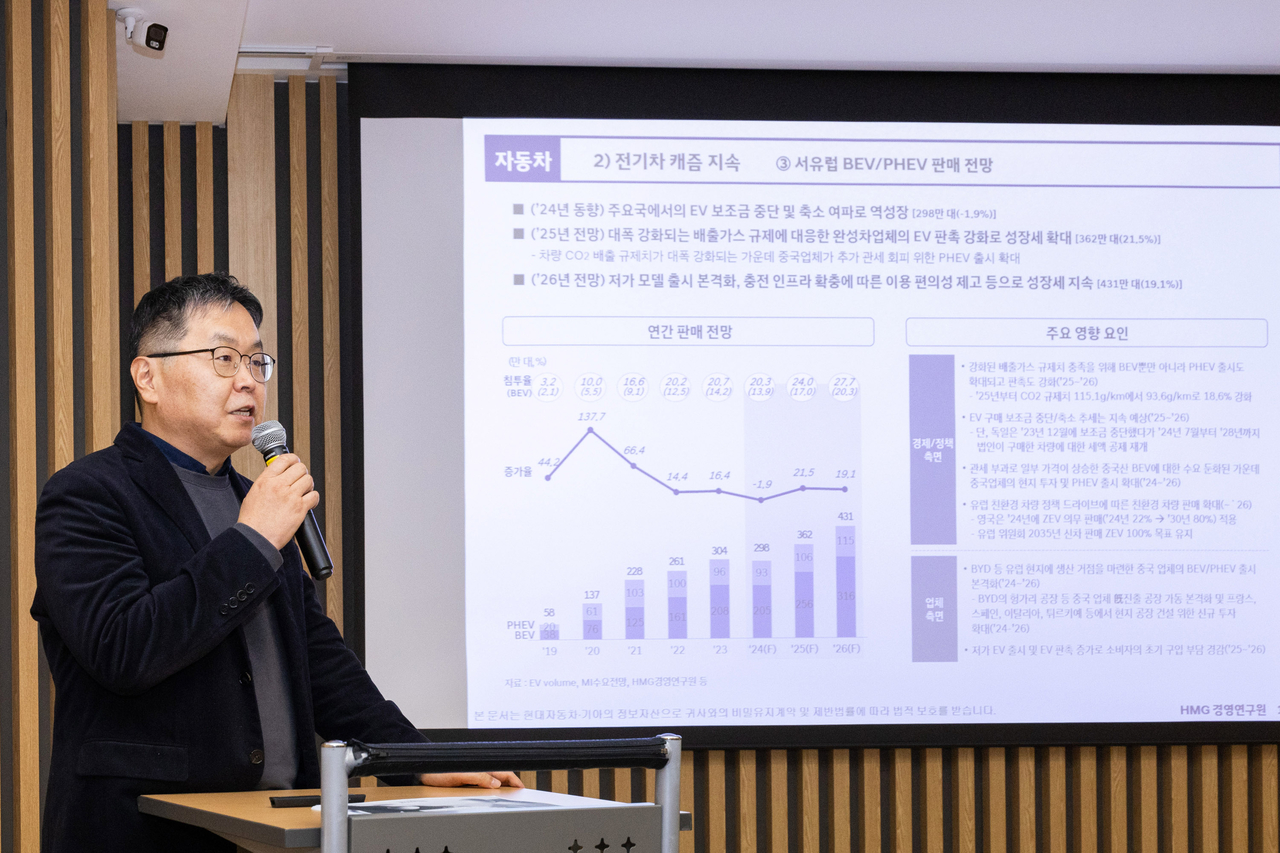
The worldwide stall in sales of battery electric vehicles is expected to continue this year as demand for better-performing and cost competitive hybrid and plug-in hybrid vehicles rises, Hyundai Motor Group's Business Intelligence Institute said Wednesday.
“We can’t really see a momentum that can bring out the growth of the EV market this year,” said Yang Jin-soo, head of the mobility industry research lab at the intelligence institute, at a seminar covering 2025 auto market forecasts. The seminar was organized by the Korea Automobile Journalists Association, and held at the Korea Automobile Manufacturers Association's headquarters in Seoul.
“So this year’s (EV) growth rate is projected to post a similar level as last year or a little bit less than that,” Yang added.
Hyundai Motor’s intelligence unit estimated last year’s global sales of battery electric vehicles and plug-in hybrid vehicles at 17.16 million, up 29.3 percent from 2023. It projected that this year’s figure is likely to reach 20.73 million, an annual increase of 20.8 percent, with next year’s number forecast to hit 24.22 million, up 16.8 percent on year.
Yang noted that the eco-friendly vehicle market in the United States is expected to grow this year with major Asian automakers such as Hyundai, Kia, Toyota and Honda rolling out new models, but advised that the incoming administration under President-elect Donald Trump could implement anti-EV policies and weaken the EV transition.
In regards to Europe, he noted that “the biggest factor in western Europe is the stronger (carbon) emission regulations.”
“(Automakers) have to increase the supply of BEVs (battery electric vehicles) and PHEVs (plug-in hybrid vehicles) and even hybrid vehicles … the rise of Chinese companies is something we have to watch closely in the European market in the mid- to long-term since some of them are already setting up new manufacturing footholds there.”
Yang explained that once Chinese automakers’ plants begin full operation in the next two to three years, they will be able to avoid tariffs and possibly lead growth in the European EV market. According to the projections, China will continue to widen the gap with other countries in the auto export sector worldwide.
The Hyundai Motor Group official noted that as the fastest growing eco-friendly vehicle market in the world, China’s penetration rate for EVs and PHEVs had likely hit 50 percent at the end of last year, with about 11.29 million eco-friendly vehicles sold there.
“Because the spread of BEVs and PHEVs is extremely fast in the Chinese market, the existing legacy (original equipment manufacturers) cannot catch up,” said Yang.
hwkan@heraldcorp.com



![[Exclusive] Ateez to return in November](https://wimg.heraldcorp.com/news/cms/2026/09/02/news-p.v1.20260902.76162fb0ba55493aad1c076f240d0750_R.jpg?type=h&h=120)