Presidential candidates wrapped up their campaign overshadowed by ideological disputes, attacks on each other’s past and hectic realignments of political forces on Tuesday.
Park Geun-hye of the Saenuri Party portrayed political experience and a record of keeping promises, conjuring up an image of a leader capable of tackling a prolonged economic crisis and the threat of North Korea.
Her rival Moon Jae-in of the Democratic United Party presented himself as a democratic and caring leader who can better accommodate the Zeitgeist of unity, communication and participation.
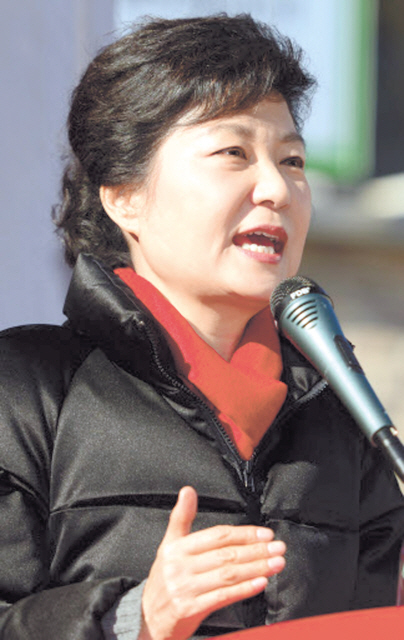
Park Geun-hye, the presidential candidate of the ruling conservative Saenuri Party, campaigns in Changwon, South Gyeongsang Province, on Tuesday. On this last day before the election, Park held a northbound cross-country canvassing tour, starting from Busan and ending late night in Seoul. (Yonhap News)
Their headline slogans reflect differing positions. Park’s “Prepared Female President” emphasizes the fact that she will be the first female president if elected and her claims of having gained experience in running state affairs while serving in the capacity of first lady for her father Park Chung-hee. It also points to her leadership of the conservative party in major elections, crises and transformative periods.
Moon’s slogan “People First” highlighted his supposed connection to the common people and his commitment to improve the welfare of poor and marginalized people.
However, the ideals embodied in the slogans took a back seat as each side concentrated on linking their rival to past failure and incumbent administrations and their leaders.
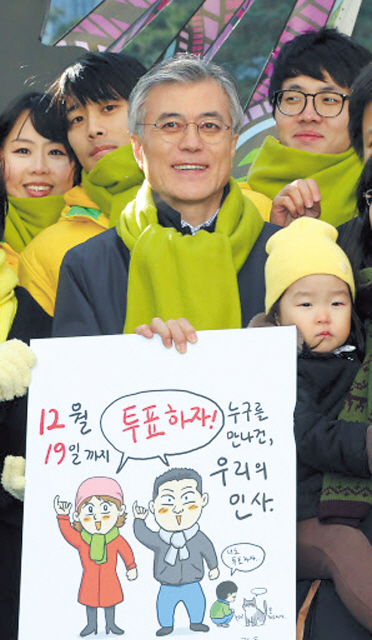
The main opposition Democratic United Party’s presidential candidate Moon Jae-in urges citizens to vote while electioneering at Gangnam Station on Tuesday. Moon canvassed major areas in Seoul before leaving for Cheonan, Daejeon, Daegu, and Busan. (Yonhap News)
Throughout the campaign Moon has reiterated the need for “new politics” to reform the country’s political environment and to root out corruption.
In pushing its agenda, the DUP repeatedly highlighted Park’s supposed position as the real power within the ruling Saenuri Party and her connection to President Lee Myung-bak.
For its part, the Saenuri Party went all out to remind the public of Moon’s role in the Roh Moo-hyun administration and its shortcomings including what it called “tax bombs” and a steep rise in housing prices.
Unsurprisingly for the conservative bloc, the main issue the Saenuri Party attempted link Moon to Roh on concerns North Korea in a move commonly referred to as “North Wind” in local politics.
In October, the Saenuri Party’s Rep. Chung Moon-hun claimed that Roh denied the legitimacy of the northern limit line in the West Sea in a one-on-one meeting with former North Korean leader Kim Jong-il during the 2007 summit.
In terms of costs, this year’s election is set to be the most extravagant in history. The ceiling for campaign expenditure is set at 55.98 billion won ($52.22 million), up 20.1 percent from 2001, and both Park and Moon have received upward of 25 billion won from supporters.
The two sides also operated the maximum number of offices, and near-maximum number of campaign vehicles allowed by law, prompting observers to estimate that each will run up costs close to 50 billion won.
The record amount spent on a presidential campaign remains the 38 billion won the DUP’s Chung Dong-young spent in 2007.
One of the more noticeable elements of Park’s campaign is the large number of high-profile “defectors” from the progressive bloc.
The first of the progressive heavyweights to switch sides was former lawmaker Han Gwang-ok, who was a DUP senior advisor until shortly before the move in early October.
He was also a long-time member of the Donggyo-dong faction ― the group of Kim Dae-jung supporters within the proto-political organization established in 1984 in collaboration with former President Kim Young-sam.
While Han said that his decision was to help achieve “national unity,” the move was widely interpreted as being motivated by figures with close ties to late former President Kim Dae-jung from the center of power within the DUP.
Han was later joined by former Democratic Party chairman Hahn Hwa-kap, also a member of the Donggyo-dong faction, and one of Kim Dae-jung’s three closest aides along with Kim Ok-du and DUP advisor Kwon Roh-kap.
Han and the others who built their political careers in the shadow of Kim Dae-jung were later joined by members of the Sangdo-dong faction ― the followers of Kim Young-sam within the same proto-political organization.
Park was not alone in seeking help from the opposing camp, with Moon counting Yoon Yeo-jun among his key policy aides.
In 1997, he served as an environment minister under the Kim Young-sam administration, before going on to serve as Lee Hoi-chang’s state affairs aide in 1998. At the time, Lee was the chairman of the Grand National Party, which has since transformed into the Saenuri Party.
For the 2004 general elections, which took place only a month after the conservatives led an attempt to impeach late former President Roh Moo-hyun, Yoon also worked as the deputy chief of the Grand National Party’s campaign committee under Park.
For Moon’s campaign, however, the main development was merging with that of former independent candidate Ahn Cheol-soo.
Even before Ahn launched his campaign, the DUP raised the issue of forming a coalition. The talks that began after prolonged wrangling between Ahn and the DUP took a convoluted route, with the process halted more than once and the party’s leadership stepping down.
Although the progressive bloc eventually formed a united front with Ahn endorsing Moon, it was marred by the drawn out and fierce negotiations that made the process far removed from Ahn and Moon’s stated purpose of achieving a “beautiful merger.”
Aside from developments within the two main candidates’ camps, the run up to this year’s election was notable in the late emergence of smear tactics, a long-standing fixture in local politics.
Although elements of each camp made charges of negative propaganda against one another throughout the campaign, it did not came to the fore until December.
On Dec. 11, the DUP reported that a National Intelligence Service employee had been posting slanderous comments about Moon on the Internet as part of a systematic attempt to influence the election. The claims prompted a police investigation, which according to the police, turned up no evidence of such goings on.
Both sides have since claimed that the developments were part of the other’s smear campaigns, with the DUP claiming that the police investigation was concluded to be favorable to the conservative party.
The Saenuri Party also honed in on the forfeiting of Unified Progressive Party candidate Lee Jung-hee, with some claiming the move to be part of a “rigged game” timed to enable Moon to hold a one-on-one debate with Park on Sunday.
“The coalition between Moon Jae-in, Lee Jung-hee, Shim Sang-jeong and Ahn Cheol-soo is not a coalition of values, but a hodgepodge coalition,” Saenuri Party spokesman Lee Sang-il said.
“There is high probability that ideological disputes and power-sharing will occur if Moon takes power.”
koreaherald@heraldcorp.com