This is the ninth in a series of articles on the growing rivalry between the U.S. and China and its implications for the two Koreas and East Asia. ― Ed.
The expected change of government in Japan after its Dec. 16 elections will not bring about a significant shift in foreign policy as the new leader will face domestic challenges of economic doldrums and political instability, a Japanese scholar said.
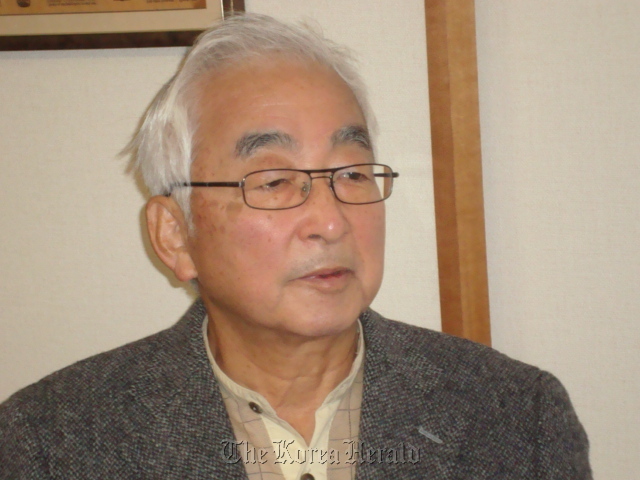
Yasuo Suzuki, a former journalist and a professor at Toyama University of International Studies, stressed the new Japanese prime minister would not have “ample room or budgets.”
“Economically, Japan has suffered its ‘lost 20 years.’ Politically, it has been troubled by its lost 10 years. … Japan’s top priority now, above all, is how to achieve economic growth,” he said in an email interview with The Korea Herald.
Yasuo Suzuki
As the main opposition Liberal Democratic Party, led by security hawk Shinzo Abe, is expected to win the elections, analysts here cautioned that the conservative party may take a more nationalistic, rightist external policy at the risk of straining ties with neighboring states such as South Korea.
In addition to what he dubs “political turmoil” caused in part by partisan politics, Suzuki cited pending domestic issues including those concerning the consumption tax, fiscal and nuclear energy policies and political conflict over whether to join the Trans-Pacific Partnership, a free trade agreement involving a dozen or so Pacific-rim states.
But Suzuki said that Abe, should he be elected, might seek to rewrite the “outdated” constitution and allow Japan’s Self-Defense Forces to have more flexibility in its overseas operations such as international peace-keeping operations.
Touching on the possibility of weakened U.S. presence in East Asia, the scholar said that South Korea and Japan can fill the “vacuum” and jointly respond to regional security challenges posed by China’s increasing assertiveness and North Korea’s military threat.
“The two countries (South Korea and Japan) have faced, and face today, a common neighbor that is struggling in its economic development, while eager to pursue a military-first policy,” he said.
“But I still believe we are on the right track. The U.S., Japan and South Korea must become the center force, and we should encourage the U.S. to cooperate with China and Russia.”
The following are the excerpts from an interview with Yasuo Suzuki.
Korea Herald: As China’s military and economic power grows, its rivalry with the U.S. is expected to intensify. What is your forecast on how their rivalry or competition will unfold?
Yasuo Suzuki: Yes, I agree with your view that as China gets stronger, economically and militarily, the competition between the U.S. and China will intensify. But there are two things that I am not sure about. The first thing is to what extent the nature of the political system of China would influence this rivalry. Communism is still the basic principle, by which China is aiming to govern its nation with a population of 1.3 billion and a land of 9.6 million square kilometers.
I vividly remember my days in Moscow, where I worked as a foreign correspondent of a Japanese newspaper from 1970 to 1975. The USSR (Union of Soviet Socialist Republics) at that time was governed by the Communist Party under the leadership of its General Secretary Leonid Brezhnev. Though the living standard of ordinary people was much lower than that of Western European nations, its military power was catching up rapidly with that of the U.S. The two superpowers were competing fiercely and the Soviet Union was striving hard to win in a global race with the free world, headed by the U.S.
Even now, I cannot forget a news clip that showed First Secretary Nikita Khrushchev while giving a speech at the U.N. General Assembly, vehemently beating the podium with one of his shoes in hand, shouting, “We bury you in 20 years.” The Kremlin tried with all its might and strategy to take over the U.S. and control the whole world. However, we have witnessed that Soviet communism came to its demise in 1991, 74 years after the October revolution.
When Mao Zedong declared the foundation of the People’s Republic of China from the wall of the Tiananmen Square in 1949, the USSR welcomed the birth of the new Communist country. Political, administrative, military, educational and social systems of the new China were patterned after Soviet systems as its model. After the two Communist powers had a vehement controversy over the Communist movement in the 1960s and particularly after the USSR fell far behind the Western world, China changed its course and invented its so-called “socialist market economy” coupled with a “reform and openness” policy under Chairman Deng Xiaoping. This new policy has, in fact, brought an extraordinary economic success to the nation.
With this great leap, can China become another superpower, a status that the U.S. has long enjoyed since the end of World War II? I am positive, but with a couple of conditions. The first condition is whether or not China can forsake its Communism and adopt democracy.
The second reason for my reservation about China’s world dominance is the long time it may take the nation to win respect and trust of the world community, similar to what the U.S. has earned and enjoyed during the past century after World War II. China is still a comparatively young nation. I believe China will yet need many years to accumulate enough respect and trust in the international community.
The dynamism of China’s economic development is fascinating. But when we think about a future world, say, 50 years or a century from now, I am not certain whether China would have become mature enough to serve the world community as a superpower that can see the world with integrity and fairness, and deal with problems of global magnitudes from such a fair and balanced perspective.
Herald: How does Japan view China’s rise as a potential global power?
Suzuki: The origin of the name China, if I’m not mistaken, came from the name of Qin dynasty. At least we were taught to that effect in elementary school. A lot of Japanese things such as chopsticks, fans, Buddhism, tea ceremonies and even the bowing custom were imported into Japan from China through the Korean Peninsula. So, China has been historically a global power for Japan. We have long accepted that China had viewed Japan as one of its satellite nations, and historically, Japan had viewed China, with a certain sense of respect, as the center of politics, culture, business and religion, during the Tung, Sui, Ming and other dynasties. But that was the case before the modern age, before the 19th century.
You are saying China is a giant nation, proud of being the second-largest economy in the world. But let us also note that China is spending a huge amount of military expenditure and impressing the world with massive plans to expand its spheres of influence. China has grown to be a military giant, too. More than a few neighbors suspect that China might see the present day as a great opportunity to wreak its vengeance, which it has accumulated over more than a century during the age of imperialistic advances by the Western powers and Japan. Such intentions of China, if China should have them, might not be difficult to understand, because today we are seeing plenty of evidences that the U.S. is losing its steam, not only as the world’s economic and financial leader, but also as its strategic and military superpower.
For a long time, China has been a continental power like Germany and France, but now China has started to become a sea-power state as well. It is even whispering that the Pacific Ocean might well be governed by two superpowers, the U.S. and China, and declaring that maritime rights and interests must be “absolute cores,” and that disputes about territories and fisheries must be solved by bilaterally, not collectively.
Japan welcomes China becoming a global power, but if China should build up its military capacity without limits, Japan will be cautious about China’s motives.
Herald: What do you think about the current and future relations between Japan and China?
Suzuki: I can tell you more easily about future relations between Japan and China. I can’t tell how long we must wait to see such relations to occur. But I would like to see something resembling today’s relations between the U.S. and Canada, or relations between France and Germany. Both sides need to respect each other. In all societies, values and human rights must be respected. Shigeki Hijino, a Japanese journalist who resides in France now, told me that an opinion poll conducted in May this year disclosed that, to the question, “Which nation do you respect most?” 84 percent of French respondents answered Germany, and 80 percent of Germans answered France.
However, current relations between Japan and China are far from such pictures. They are quite tough and rough. I see a couple of reasons for that. First, China seems to be in a volatile condition. China has just finished its 18th Communist Party Congress, where Xi Jinping took over power as the party’s general secretary from Hu Jintao. Xi has also captured the power over the People’s Liberation Army. The new Chinese leadership consists of two different groups, one being the Youth Communist Organization, and the other the High Cadres’ Children, with strong ties with the military. Former General Secretary Jiang Zemin, a hard-liner in both home affairs and diplomacy, is said to be still influential inside the party.
Right now, China’s new administration is in a delicate situation, too delicate to set a new foreign policy, especially a policy vis--vis Japan. The two recent incidents attracted wide attention, both domestically and internationally. One was Bo Xilai’s dismissal from the party. He had been the secretary of Chongqing City’s Communist Party committee and long considered a candidate for the politburo member. The other is the New York Times article that alleged that Prime Minister Wen Jiabao’s family might have amassed a huge fortune through the initial public offering of a Chinese bank.
As often said, a third country could be used as a “scapegoat” to divert political sparks. Japanese government’s decision to make Senkaku islands a national property might have been used for such a purpose, and the Japanese-Chinese relations were soured.
I must add one thing. Regarding this problem, Japanese Prime Minister Yoshihiko Noda made an unfortunate error by deciding the government’s purchase of Senkaku islands just two days after Chinese leader Hu Jintao asked Mr. Noda not to do so in Vladivostok, during the ASEAN Summit there. It meant a total loss of face for Mr. Hu and China generally.
Herald: Some express concern over Japanese politicians’ move toward the right on the political spectrum. What do you think about the reasons for Japan’s “rightward” shift? How do you think such a conservative stance could affect Japan’s foreign policy in relations with South Korea and China?
Suzuki: There are two characteristics of Japanese politics today.
One is the disastrous misgovernment by the Democratic government. You might know there were three prime ministers during its three-year rule. The first prime minister Yukio Hatoyama, severely damaged Japan-U.S. relations and the process of rearranging U.S. bases in Okinawa. The second prime minister, Naoto Kan, failed to control the heretofore unknown damages caused by the earthquake and tsunami at the Fukushima Daiichi Nuclear Power Plant. The third prime minister, Yoshihiko Noda, has done much better than his predecessors, but Japan’s economy has continued to be sluggish.
The second is Japan’s political “turmoil.” When the Japanese people voted for the Democratic Party three years ago, they wanted to see a two-major-party system function much like in the U.S. and the U.K. However, what we found was a Democratic Party consisting of three or four factions, with many of their policies being much the same as those of the Liberal Democratic Party.
Now a general election will choose new lawmakers in the lower house on Dec. 16. Nobody can tell what will happen. All I can say is there are two possibilities. One possibility is a coalition of the three major parties, with the LDP as the principle party, joined by DPJ and Komei Party. The other possibility is the LDP tying-up with a few so-called the “third pole” parties.
Under such “turmoil,” no significant foreign policy change could be expected. Japan faces a number of vitally important domestic issues to address, and they are the nation’s priority.
The first issue is whether to shelve the 3 percent increase of consumption tax as the first step. The second is whether to adopt a drastic fiscal policy with a 2 percent inflation target and a possible revision of the Bank of Japan law. The third is whether Japan should join the TPP (Trans-Pacific Partnership ― a free trade agreement with a dozen or so Pacific-rim countries) negotiations or not. The fourth concerns Japan’s future energy policy, including an abolition of all atomic power stations in the 2030s. In short, the nation’s economic recovery is a far more important matter for the incoming government.
Who will become Japan’s next prime minister is a question nobody can answer correctly (with certainty). But it’s not such an important question, because no new prime minister can have ample room and budgets. Should Shinzo Abe be elected, he might try something symbolic. The first is he might make a move toward adopting a new constitution. Many in Japan feel our constitution is outdated on many points. Needless to say, it has been more than 60 years since the present constitution was promulgated, and it was drafted by the U.S. and introduced to the Japanese Diet.
When you say a possible “rightward” shift, do you mean a renaming of the Self-Defense Forces to National Defense Forces?
Well, Japan has some real problems if its present armed forces continue to use their present name and abide by their present rules. For example, in principle, the SDF is restricted to engage in any action within Japan’s own territorial waters and air space. When the SDF is asked by the U.N. to participate in peacekeeping operations, each time they must obtain a special permission from the parliament, which takes weeks and months. It is especially embarrassing for the SDF when they are serving in the U.N. mission with military forces of other member nations. When a member nation’s forces are attacked by unknown hostile elements, SDF soldiers are not allowed to respond with fire. Changing the name is no big deal, in my view. But should Mr. Abe try to adopt a totally new constitution, it won’t be easy. Under the present situations, he won’t succeed. For him to go through it, security situations around Japan must be worsened.
Herald: The U.S. apparently wants closer security cooperation between Seoul and Tokyo. But historical, territorial disputes always get in the way. What do you think about the way to resolve such disputes and to set up a more future-oriented, practical relationship?
Suzuki: When we discuss the international situation in the Far East and Northeast Asia today, we must recognize two fundamental streams that have taken place these days.
The first is the shift of the world center from the Atlantic to the Pacific. You might also say that the importance of Asia is increasing very rapidly. The second is the shrinking superpower status of the U.S., so that the U.S. can no longer rule the world as its policeman.
Under this new situation, Japan needs to beef up its foreign policy to help consolidate a more stable and prosperous world without large-scale armed conflicts.
Washington surely wants closer, friendlier and mutually beneficial relations between Seoul and Tokyo. Security cooperation is a vital area in such relations. The two countries have faced and face today a common neighbor that is struggling in its economic development, while eager to pursue a “military-first” policy that includes aiming to possess nuclear weapons and strategic missiles. The six-party talks have continued long, bearing little fruit.
But I still believe we are on the right track. The U.S., Japan and South Korea must become the center force, and we should encourage the U.S. to cooperate with China and Russia.
The USSR is now gone. Terrorism instigated by religious groups is increasing. China has developed its economy and has come into the international arena as a new superpower, with its new expansionism evidenced in marine power. North Korea is desperate to remain a player in the international scene with a “military-first” philosophy and nuclear arms.
Herald: What do you think about Japan’s future position in East Asia? What kind of a regional or global status do you think Japan is pursuing in the dynamics of power in this region and beyond?
Suzuki: This might sound too idealistic, but I want to see Japan become the center of excellence in East Asia. What I mean by the center of excellence is that Japan should become a model country and give assistance to other countries in the region, both financially and technologically, in such fields as social welfare, medicine, city and town infrastructure, IT industry, and higher and vocational education. Japan has a good basis to become a center of academic research and training. Japan could invite tens of thousands of scholars and graduate students to its universities, research and other institutes and even research labs attached to big corporations.
Yasuo Suzuki ● Yasuo Suzuki, with nearly three decades of experience in journalism, is currently a visiting professor at Toyama University of International Studies.
● Graduating from the Russian department at Tokyo University of Foreign Studies in 1964, he joined The Yomiuri Shimbun. He served as special correspondent in Moscow, Bangkok and Washington D.C. In 1990, he also served as foreign editor at the newspaper.
● After leaving the paper in 1991, he began his teaching profession at the Jichi Medical School. He joined the TUINS in 2005.
● He has authored a series of books on Russia and other political topics: “Soviet Society and People’s Life (1978)”; “USSR under Gorbachev (1987)”; “English on the Scenes (2003)”; and “Media and International Politics (2005).”
● He has also translated into Japanese “Gorbachev Memoirs (by M. Gorbachev, 1996)”; “After Victory (by J. Ikenberry, 2003)”; and “Another Russo-Japanese War (by K. Sarkisov, 2009).”
koreaherald@heraldcorp.com