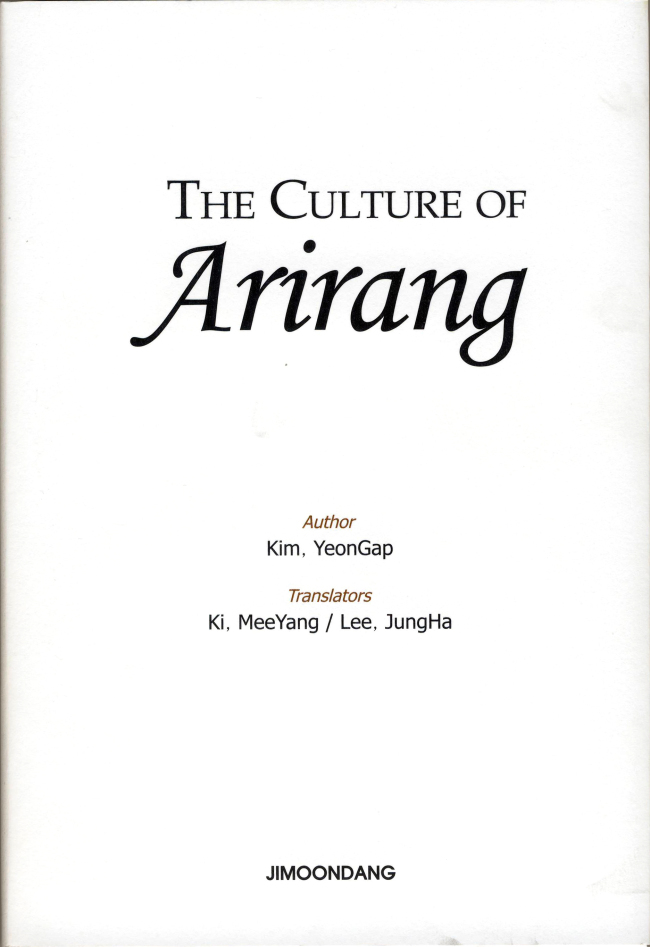
“Culture of Arirang” (Jipmoondang)
An English book highlighting the history and the cultural significance of the Korean folk song “Arirang” was released on Monday.
The book, “The Culture of Arirang,” written by a local scholar Kim Yeoun-kab and translated into English, is expected to promote the song and Korean culture ahead of UNESCO’s general meeting in December at which the enlisting of the traditional song as an intangible cultural heritage will be discussed.
The book traces the tradition of Arirang, believed to have originated from “Arari,” a local folk song of Jeongseon in Gangwon region during the Yemaek era (B.C. 2-A.D.2 century), and how it has developed into more than 50 different versions throughout Korea. The Jeongseon area still maintains the word Arari instead of Arirang.
“All Arirang songs have one thing in common ― they have ‘Arariyo’ as a refrain and the word, ‘Arirang’ is mentioned throughout the songs repeatedly,” said Kim, who is also executive director of the Korean Arirang Association, a private group.
Arirang survived the “cultural wipe-out” policies of the Japanese colonial rule (1910-1945) and a movie titled “Arirang” was produced in 1926. The movie is said to have led the spirit of resistance against the Japanese colonial rule among Koreans. After the liberation the song became the title of an international tour by “Little Angels,” a group of young performers who performed traditional dances and songs, including “Arirang,” around the world.
In 2002, 2006 and 2010, “Arirang” filled the air as one of the cheerleading songs for the national football squad during the World Cup games.
“The song was with us at all important events,” Kim said.
The author said the significance of “Arirang” lies in the fact that it represents the Korean sentiment of resistance, oneness and coexistence that unite the people of Korea together.
Kim took North Korea’s aggressive promotion of “Arirang” as an example.
“North Korea has acknowledged ‘Arirang’ as the culture of Koreans and has been eager to promote it as a valuable asset of the people,” Kim said. “Therefore, I believe ‘Arirang’ will be the bridge between the two Koreas in cultural aspect. Though we have been divided for more than half a century, both sides enjoy the same song under the same spirit.”
So it is for the millions of Koreans living outside Korea. Korean descendants living in northern China sing “Jangbaek (Mt. Baekdu in Korean) Arirang” while some Korean Americans joke that their lives are “L.A. Arirang.”
“Arirang is more than a folk song. It is an independent part of our culture and spirit that brings us together. Every country has an inexplicable sentiment they share and enjoy. In Korea, that’s ‘Arirang,’” Kim said.
Kim plans to distribute the book to overseas readers through the Korea Foundation.
By Bae Ji-sook ()
koreaherald@heraldcorp.com