Bills related to inter-Korean economic issues proposed by Saenuri Party lawmakers for the most part are concerned with the use of funds for relevant activities.
The only exception is a bill proposed by Rep. Hwang Jin-ha that is aimed at increasing inter-Korean economic activities.
The bill proposes the establishment of a “special unification economic zone” close to the border.
The bill proposes that the economic zone be an independent entity free from taxation and state control from both Seoul and Pyongyang.
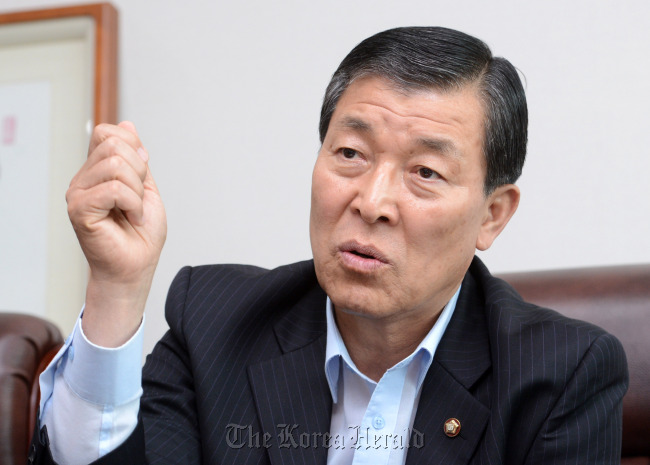
Hwang Jin-ha
In the long term, Hwang and the cosponsors of the bill envision a plan where the new zone and the Gaeseong Industrial Complex in North Korea will provide the starting points for a more extensive “special unification economic zone.”
The bill also proposes a new presidential committee, and a new government agency to oversee all related matters.
“The bill has been prepared since the 18th National Assembly, and we are currently holding follow-up discussions,” Hwang said.
Among other bills, Rep. Lee Myong-su’s proposal calls for the establishment of a new unification fund.
In 2010, President Lee Myung-bak proposed a “unification tax” as a means to build up resources to cover the cost of reunification of the peninsula. According to a study conducted by the Ministry of Unification, minimum of 55 trillion won ($50 billion) will be required in the first year of unification if the two Korea’s are unified in 2031.
The bill proposes that a state fund be established with contributions from the government and others, and to allow the unification fund to take out long-term loans from other state-operated funds and financial institutions.
The other two bills call for a partial or complete revision of the Inter-Korean Cooperation Fund Act.
Legislated in 1990, the Inter-Korean Cooperation Fund Act stipulates the establishment of the fund and regulations over its use.
The complete revision suggested by Rep. Chung Ui-hwa and 22 other lawmakers proposes merging the Inter-Korean Cooperation Fund with that for accumulating financial resources for the cost of reunification.
Under the proposal, the new act will govern the operations of two separate accounts, inter-Korean cooperation account and unification account.
The bill proposes that the account for inter-Korean projects before reunification will be managed in the same way as the current fund, while 1 percent of the government’s inland revenues be directed into the unification account to accumulate funds.
The partial revision proposed by Rep. Lee Byung-sik is adds a clause allowing the use of the Inter-Korean Cooperation Fund for projects for securing professional human resources, information and infrastructure to facilitate “smooth and systematic” execution of inter-Korean projects.
The current Inter-Korean Cooperation Act is focused mainly on supporting the operations of relevant projects.
By Choi He-suk ()
koreaherald@heraldcorp.com