Well-educated, female, 40-something, a white-collar worker and living in Seoul ― chances are that she may be one of the floating voters that hold the key to the cliffhanger race for the presidency.
Adding drama and unpredictability to the Dec. 19 election is a higher percentage of swing voters than before. Polls show that fewer people are undecided, but more are open to changing their minds.
Driven by demographic changes, this year’s voter makeup breaks a few records, too. Their number surpasses 40 million for the first time for a presidential election. The portion of the electorate aged 50 and over, deemed largely conservative, exceeds those under 40, seen as liberal, for the first time.
The voters are also better educated. More than 80 percent of eligible voters are at least high school graduates.
Expanding electorate
According to the Ministry of Public Administration and Security, the South Korean population was 50,891,223 at the end of September. Of them, more than 40 million were eligible to vote. The exact size of the electorate for the presidential vote is to be finalized on Dec. 10.
The electorate gradually expanded from around 32 million for the 1997 presidential election, to 35 million in 2002, and 38 million in 2007.
Those in their 50s and over make up 39.6 percent of the entire electorate, larger than the 18.2 percent of those between 19 and 29, 20.3 percent of those in their 30s, and 21.9 percent in their 40s.
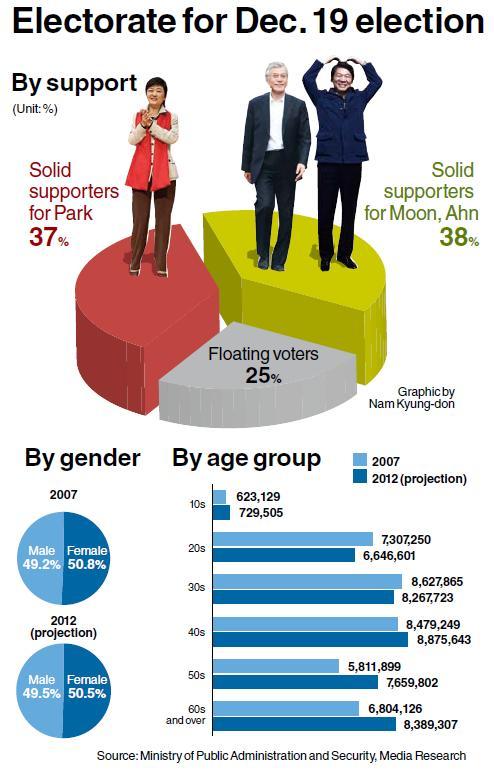
The electorate aged less than 40 has been consistently declining, from 48.3 percent in 2002 to 43.8 percent in 2007. This was the case even when the voting age was lowered to 19 from 20 in 2006.
Undecided voters “It is usually said that 30 percent of the Korean voters are progressive, another 30 percent conservative, and the remaining 40 percent, moderate,” said Yoon Hee-woong, a senior researcher of the polling agency Korea Society Opinion Institute.
Undecided voters are usually those with minimal interest in politics and without an ideological standing. They therefore watch the campaign from a neutral point of view until the end before making up their minds. Moderates, on the other hand, are repulsed by any radical ideology.
A large portion of undecided voters tend to be moderate and non-partisan voters.
The reason why the moderate stratum is important is because the voting rate is expected to be as high as 70 percent, said Yoon.
“Compared to around 55 percent voter turnout for parliamentary and local elections, a presidential contender needs more than his or her sturdy supporters.”
When combining various surveys conducted by pollsters, the undecided voters take up 5 to 10 percent of the respondents. They are considered by polling experts to be different from the general floating voters, who support a candidate but are prone to changing their minds.
The survey by Realmeter last week showed that the number of undecided voters was 5 percent, the lowest rate in recent history. It was 25 percent around the same period in 2007 and 12 percent in 2002.
The noticeable decline is generally attributed to independent Ahn Cheol-soo, as many of the moderate and non-partisan voters leaned toward him this time whereas they remained undecided or didn’t vote in the past.
40s and 50s
Another point of change is the coupling of the 40-something voters with those in their 20s and 30s. While many of them chose President Lee Myung-bak in the 2007 election, they voted for the opposition candidates in the 2010 regional elections. The age group is considered to hold the casting vote in the election in two months’ time.
For the time being, 40-something voters are showing a tendency close to the younger generation.
Gallup Korea’s survey on Oct. 8-10 showed that in a two-way race, they preferred Rep. Moon Jae-in of the main opposition Democratic United Party or Ahn Cheol-soo, rather than conservative ruling Saenuri Party’s flag bearer Rep. Park Geun-hye. In one-on-one matchups, both Moon and Ahn enjoyed over 50 percent of support against Park among the respondents in their 40s.
The demographic, however, remains volatile. Gallup Korea’s earlier survey on Oct. 4-5 placed the DUP (35 percent) above the Saenuri Party (30 percent), but the two quickly changed places with the Saenuri Party seeing 36 percent support and the DUP 26 percent just several days later on Oct. 8-10.
Observers said such a phenomenon indicates that 40-something voters are sensitive to the political situation, rather than them moving ideologically.
“Ideologically, while 40-somethings remain as progressive as they were in their 30s, they have become largely conservative in everyday life as they grow older,” Yoon said.
Professor Shin Yul of Myongji University agreed.
“The 40-somethings are the generation that have the bodies of the conservatives but the heads of progressives. The voting rate of this age group is closely intertwined with the economic situation, and the rate is likely to surge if the economic crisis aggravates at the year-end.”
The 40-something voters take up 21.9 percent of the entire electorate for the presidential election.
Another substantial change is among the voters in their 50s, who have conventionally been described as conservative.
While those in their early 50s ― those between 50 and 54 ― show ideologically similar tendencies to the 40-somethings with a combination of progressiveness and conservativeness, those in their late 50s ― those between 55 and 59 ― tend to be sturdy conservatives.
The 50-somethings are the baby boomers born between 1958 and 1962, who have enjoyed high levels of education. They have also experienced the dynamic upheavals of Korean politics, including the Burma movement in 1979 against the Yushin regime of former President Park Chung-hee, the Oct. 26 assassination of Park in 1979, and the May 18 democratic movement in 1980.
A survey jointly conducted by daily Munhwa Ilbo and Korea Research showed that those in their 50s preferred Park Geun-hye over Ahn Cheol-soo 52.1 percent to 42.4 percent as of Sept. 24. The gap was much narrower at 4.9 percentage points (50.0 percent for Park and 45.1 percent for Ahn) among those between 50 and 54, while it was 16.1 percentage points wider (54.9 percent for Park and 38.8 percent for Ahn) among those between 55 and 59.
Floating voters
Aside from the strong supporters of either Park Geun-hye, Moon Jae-in or Ahn Cheol-soo, the floating votes up for grabs are measured at 25 percent, according to the survey and analysis conducted by Media Research. The fixed supporters of Park come to 37 percent, and 38 percent for the opposition candidates.
The floating voters refer to those who showed inconsistencies in their responses, such as by supporting Park in a matchup against Moon but picking Ahn over Moon, or remaining unresponsive.
By age, the ratio of floating voters was the largest, at 33 percent, among those in their 20s, while they were between 24 and 25 percent among those in their 30s, 40s and 50s. These swing voters were least found among the 60-somethings at 18 percent.
By region, 27 percent of those living in Seoul and the surrounding metropolitan areas held the swing votes. The percentage of floating voters was high among students (33 percent) and business employees (26 percent), and largest among moderates (30 percent), compared to progressives (23 percent) and conservatives (21 percent).
The floating votes were more common among the opposition candidate supporters, with 33.3 percent and 34.4 percent of respondents that had selected Moon and Ahn, respectively, indicating they may have a change of heart, compared to around 20 percent among those who chose Park, according to another survey conducted by Research & Research and DongA Ilbo.
More women were seen to hold swing votes and many of them were working white-collar jobs in the surveys by KBS and SBS.
Observers point out that these voters weighing their options between the two opposition candidates may not necessarily vote for either in the end, considering their disillusionment with established politics. They instead may decide to give up their vote altogether and remain undecided if there is a single candidacy, the pundits say.
Wary of such a possibility, both the camps of Moon and Ahn are increasingly cautious about painting a rosy picture of a single candidacy.
“We feel the grave responsibility to succeed (in the election) for the sake of administrative change and political reform. However, the theory that we will win without a doubt if we merge the candidacy is something that we must guard against,” Park Sun-sook, co-head of Ahn Cheol-soo’s election campaign headquarters said at a press briefing Monday.
“As confirmed by various news reports, there is a need for a fundamental review on whether the gaps in the two-way contests among the candidates are reliable and optimistic,” she added.
Chung Dong-young, supreme councilor of the DUP and chair of Moon Jae-in’s committee on inter-Korean economic cooperation and union, echoed Park’s concern.
“It is an illusion that we would be able to achieve the administration change only if we succeed in a single candidacy,” Chung said at a press conference Monday. “According to a simulation that minutely calculated the generational voting rates, the ruling party candidate is leading by at least 1 million votes.”
“We cannot repeat the forlorn history of being defeated after getting ahead of ourselves by depending on the single candidacy,” he added, referring to the Saenuri Party’s surprise victory against the DUP in the April 11 general elections.
By Lee Joo-hee ()
koreaherald@heraldcorp.com