Moon to confront popular Ahn Cheol-soo, differentiate economic policy from Saenuri’s
After an overwhelming victory in the Democratic United Party primary, Rep. Moon Jae-in now faces possible competition with a tougher rival, Ahn Cheol-soo, for a unified liberal candidacy, while regrouping his party hit by factional strife and voting disputes.
The former human rights lawyer and chief of staff to the late President Roh Moo-hyun won 56.52 percent of the vote during the three-week race which wrapped up Sunday.
Entrepreneur-turned-professor Ahn, highly popular among young, progressive voters dissatisfied with the established parties, is expected to declare his bid for Cheong Wa Dae this week.
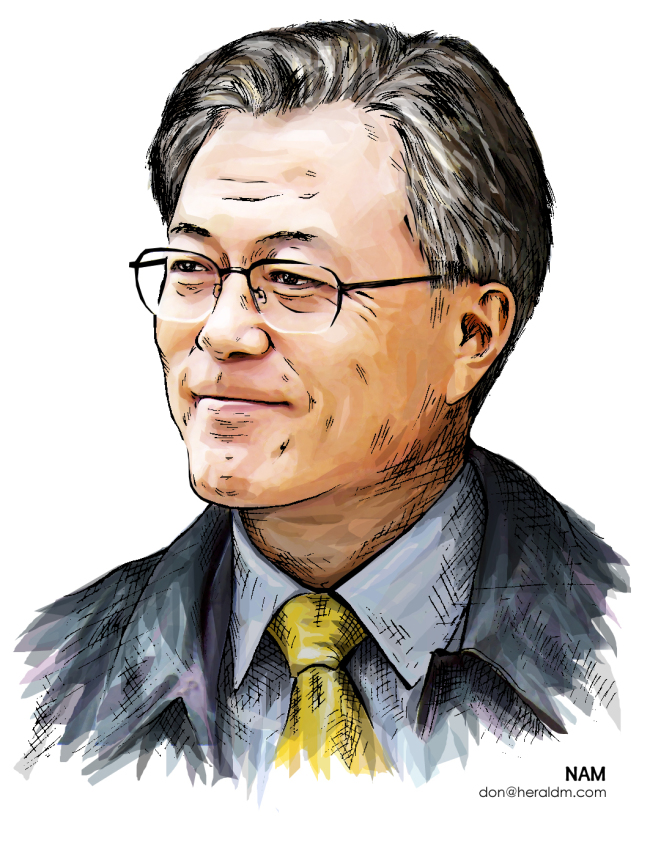
Moon Jae-in
The Seoul National University professor has yet to clarify whether to run independently or join the DUP later. He has remained opposed to the ruling Saenuri Party taking power again.
The most likely scenario, observers say, would be that Moon and Ahn strike an agreement to unify candidacy that would cover the broader liberal political camp and civil society.
Dismissing the possibility of the two engaging in an ugly political wrangling over candidacy, some anticipate that Moon may push for a “joint cabinet” in which they would cooperate to manage state affairs.
Whatever choice they make, observers say their decision should be made as quickly as possible to give enough time for candidates to compete on their policies and face the due vetting process, and for voters to decide which candidate should lead the country for the next five years.
For the Dec. 19 election, each candidate is to register with the National Election Commission from Nov. 25-26.
Reaching a compromise between the two may not be easy as the DUP is desperately seeking to field its own candidate.
It would be a disgrace, observers note, should the party with 128 lawmakers in the 300-seat legislature fail to have a candidate of its own. During the Seoul mayoral by-election last year, the party failed to put forward its candidate after unifying candidacy with civil society candidate Park Won-soon.
For Ahn to join any political machine is also unlikely, analysts say, as it could tarnish his non-partisan image that has catapulted him to his current status.
“Should the race become a three-way competition, chances are low for the opposition. They know that. Thus, it is likely for Moon and Ahn to unify candidacy,” said Yoon Pyung-joong, a political philosophy professor at Hanshin University.
“But (Ahn’s entering the DUP) is unlikely given that his popularity comes from his non-partisan image. Politically using the DUP for his bid is like losing his strength built on the fact that he was not a professional politician.”
Ahn runs neck-and-neck with Rep. Park Geun-hye, the ruling Saenuri Party’s standard bearer whose candidacy was confirmed nearly a month ago.
According to the recent survey of 1,500 voters conducted last week by pollster Realmeater, Park garnered 45.5 percent, slightly leading Ahn by 0.3 percentage point.
The gap was larger until recently as public fatigue grew over Ahn’s indecisiveness. But the controversy over Park’s failure to properly address the calls to recognize alleged rights abuses during the rule of her father and late leader Park Chung-hee apparently narrowed her lead, analysts said.
In a separate one-on-one scenario survey by the same pollster, Park was in first place with 46.1 percent with Moon garnering 42.7 percent, with a plus or minus 2.5 percent margin of error.
The rival parties are expected to step up efforts to drive up their candidates’ support ratings ahead of the Chuseok holiday during which family gatherings play a crucial role in shaping pubic opinion. The three-day holiday begins on Sept. 29.
Another challenge facing Moon is to differentiate his economic policy from that of the Saenuri’s candidate to court regular voters who have suffered from deepening economic polarization.
In an apparent shift from the conservative party’s policy focusing on growth and tax cuts for the rich, the Saenuri has recently moved toward economic democratization, presaging a partial reform of the conglomerates that have long dominated the local industry.
Some dismissed the Saenuri’s move as populist while others argue that it has effectively stolen the limelight on the particular economic agenda dominated by the liberal party.
“The DUP, the liberal force, has first led the agenda of economic democratization. But it seems that it is now lagging behind the Saenuri Party. It now needs to present more policy details that clearly set it apart from its rival,” said Yoon of the Hanshin University.
To smooth out his road to presidency, Moon also needs to mend fences with his rivals within the party and make them coalesce behind him, experts said.
During the primary process, the party has shown much division among several factions ― one affiliated with the late leader Roh and others. Among the party’s presidential candidates, they had bickered over the mobile voting process, challenging the fairness of the nomination competition.
But experts say that such intra-party conflicts are a natural part of the nomination contest, and that the party will soon rally behind its standard-bearer considering Moon’s overwhelming victory in all 13 regional primaries.
After graduating from the law department of Kyung Hee University in 1980, he passed the state bar exam in the same year. He then worked as human rights lawyer with former President Roh.
Moon served as senior presidential secretary for civil affairs and chief of staff during Roh’s presidency from 2003-2008.
koreaherald@heraldcorp.com