Korean researcher makes Nature magazine with nanotech breakthrough
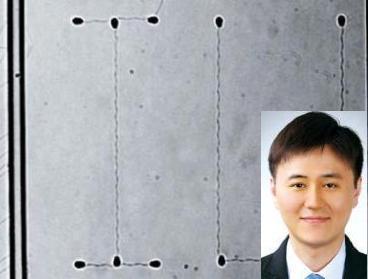
The research was featured on the cover of Wednesday’s issue of Nature. It is the first time a Korean study has been on the cover of the world’s most authoritative scientific journal.
Nam Koo-hyun of Ewha Womans University, who led the research, said his discovery may pave the way for the development of a cheaper and quicker way to produce nano-channels.
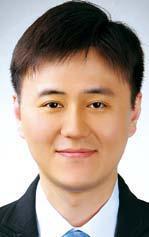
Nam Koo-hyun
His team is the first to discover a technique to control cracking and make use of it, he said.
“The formation of cracks is traditionally considered an unpleasant phenomenon because we thought it is impossible to control,” Nam told The Korea Herald.
Nam’s team used silicon wafers, thin slices of semiconductor material, in their experiment.
They created micro-scaled cuts in a thin brittle film deposited on the silicon in order to control the starting point of cracking, and put a “crack-stop-structure” to terminate the cracking.
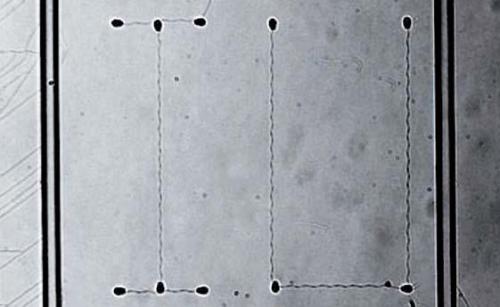
Nam’s team created 10-nanometer-sized channels, which read I.U., the name of a Korean pop singer, by controlling cracking patterns.
The nano-channels that are small enough to allow ions or molecules of a certain size to pass through are highly in demand in chemistry and molecular biology, such as DNA analysis.
But until now it has been difficult to make individual artificial channels of such a small size with current fabrication technique.
The team, however, suggests they can produce nano-channels more easily by using their cracking-control method. They had already made artificial channels that are merely 10 nanometers in size during their experiment.
“We would finally be able to reach to the artificial atomic-scale patterning if wild crack is well controlled. This is a good start for such a big goal,” Nam said.
The researcher, however, admitted that there are still limitations in their technique as it was proven in just several materials.
“We cannot say at the moment that crack control can be achieved with any materials,” he said. “But at the same time we can say that there are many other materials to find a lot of interesting crack control.”
The Ministry of Education, Science and Technology, which funded the project, said the discovery will open a new chapter in Korean science.
By Oh Kyu-wook (596story@heraldm.com)
koreaherald@heraldcorp.com