Gyeonggi Gov. Kim Moon-soo, the first politician to announce his presidential bid, is known for his unconventional path from pro-democracy student activist, to hard-line labor leader, and then outspoken right-wing politician.
The former lawmaker and second-term governor will join the ruling Saenuri Party’s presidential primary in August to challenge formidable party leader Park Geun-hye.
His bold charge may not be opportune. He has been sarcastically nicknamed “the Governor,” referring to his authoritarian tone taken when he called the 119 emergency hotline late last year.
Kim faced public criticism late when two officers were transferred to other stations after failing to recognize the governor on the phone and refused to clarify their name and rank.
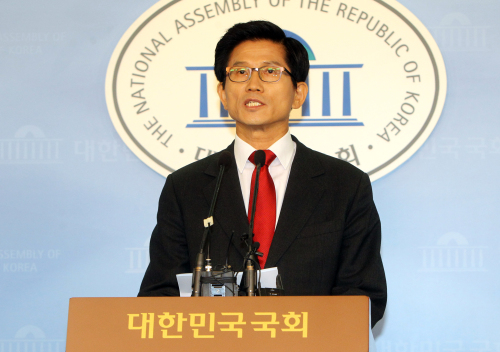
Gyeonggi Gov. Kim Moon-soo announces his presidential bid on Sunday. (Yonhap News)
Also, he is not regarded as a credible alternative to Park, who solidified her political status as party leader and presidential candidate through an upset win in this month’s parliamentary elections.
Kim’s key strategy is to differentiate his political character from that of Park.
“Rep. Park and I have lived completely different lives,” Kim told reporters Sunday after announcing his candidacy.
“It would otherwise have been a waste for me to join the primary against her.”
Kim is a rare figure within the conservative camp as his roots are in the labor movement.
Born in 1951 in Yeongcheong, North Gyeongsang Province, he joined a prestigious high school and excelled academically, but was suspended indefinitely from college for leading a student rally against former President Park Chung-hee’s constitutional revision.
In 1970, Kim was granted admission to Seoul National University’s Business Administration Department, but soon joined labor campaigns and covertly entered a sewing factory.
He was ultimately expelled from SNU for his involvement in a national student anti-government union and was imprisoned twice for leading labor rallies in the metropolitan area.
These experiences contrast starkly with those of Park, daughter of the deceased iron-fisted president.
“I fundamentally belong to the working class,” he said. “Rep. Park may have her advantages, but has limits in understanding the lives of the people.”
His outspoken comments and easygoing manner also differ radically from Park’s reserved character.
“Kim, as a potential president, should be able to embrace a wide range of supporters, but often seems to push away center-right voters with his extremely conservative words and unyielding attitude,” Beopryun, leader of Buddhist civic group Jungto Society said recently.
The activist first joined the political arena in 1994 under former President Kim Young-sam, and served as lawmaker for three consecutive terms until he won the Gyeonggi Province governor post in 2006.
After being reelected in 2010, Kim boosted his chances as a potential presidential candidate, but his support rate has remained below expectations.
Kim’s bold candidacy announcement is regarded as an attempted counterattack on Park’s rising popularity and form a non-Park faction before the party’s leadership election next month.
Only three party lawmakers have so far pledged their support for Kim ― Reps. Cha Myeong-jin, Lim Hae-kyu and Kim Dong-sung, who have all failed to win seats in the recent parliamentary race.
They nevertheless argue that Kim has a fair chance of winning votes from fundamentalist conservatives who oppose the recent progressive shift taken by the party and Park.
The ambitious governor also referred to his victory over popular left-wing candidate Ryu Si-min in the 2010 election, claiming to be able to win the favor of reform-inclined center-right voters.
The aspiring presidential candidate admitted that he faced a hard fight, not only against liberal rivals, but against party favorite Park.
“I have no money, people or organization, but my heart guided me to follow this path for the sake of the people,” he said.
“I believe that I can break a rock with an egg, if only I can give new hope to the disenchanted voters.”
By Bae Hyun-jung (tellme@heraldm.com)
koreaherald@heraldcorp.com