The United States and North Korea have a long way to go until they find a breakthrough in the standoff over the multilateral nuclear disarmament talks, a visiting senior U.S. official said Thursday.
“It would be fair to say that we did make some progress,” Kurt Campbell, assistant U.S. secretary of state for East Asian and Pacific affairs, told reporters. “(But) there were no breakthroughs. There is a substantial amount of work that needs to be done. No decisions have been taken about next steps.”
Campbell, who made a brief stop in Seoul at the end of his Asia tour, shared his views during a breakfast meeting with South Korea’s Deputy Foreign Minister Kim Jae-shin Thursday.
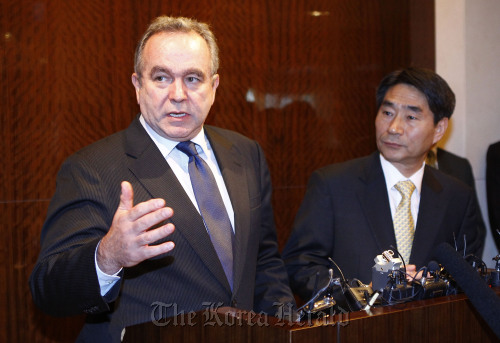
Kurt Campbell, assistant U.S. secretary of state for East Asian and Pacific affairs, answers a question from reporters during his brief visit to Seoul on Thursday. On the right is Deputy Foreign Minister Kim Jae-shin. (Yonhap News)
The comments by Campbell come as representatives from Washington and Pyongyang held two-day talks in Geneva earlier this week in a bid to narrow their gap over the suspended six-nation dialogue aimed at denuclearizing North Korea. The negotiations involving the two Koreas, China, the U.S., Japan and Russia have been stalled since December 2008, ramping up regional tensions.
Both Washington and Pyongyang said they had some positive talks, sparking optimism that the long-stalled denuclearization dialogue may soon reopen. Neither side provided specifics.
“Frankly, we are still in the process of going carefully through every aspect of what was a full day and a half of talks,“ Campbell said. ”We clearly stated our position on pre-steps ― those were closely coordinated with South Korea ― but as I indicated, we still have some work to do.”
Seoul and Washington want North Korea to follow a 2005 agreement requiring verifiable denuclearization in exchange for better relations with its Asian neighbors.
As one of the preconditions, the two allies are demanding Pyongyang freeze and fully reveal its uranium enrichment program ahead of the talks and let outsiders resume inspecting its main nuclear complex.
In November last year, Pyongyang revealed a sophisticated uranium enrichment facility, triggering concerns that the communist state has secured a second way of building nuclear bombs in addition to its existing plutonium program.
By Shin Hae-in (hayney@heraldm.com)