‘Peace Eye’ expected to bolster military reconnaissance capabilities
The first early warning and control aircraft, which will significantly bolster South Korea’s reconnaissance capabilities, arrived at an Air Force base in Gimhae, South Gyeongsang Province, Monday.
Developed by the U.S. defense giant Boeing, the E-737 Peace Eye left its Seattle factory last Saturday after having finished test flights and other technical examinations, officials at a state military acquisition agency said.
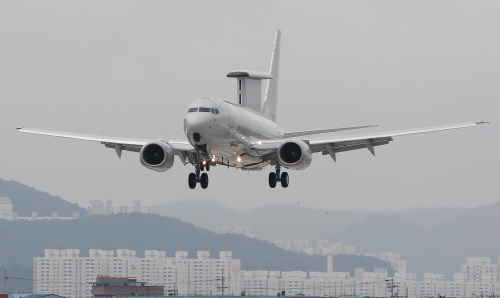
The Peace Eye, an early warning and control aircraft developed by the U.S. defense giant Boeing, arrives at an Air Force base in Gimhae, South Gyeongsang Province, Monday. (Yonhap News)
The high-tech aircraft, dubbed an “airborne command post,” will be delivered to the Korean Air Force in September after additional testing to check whether it can adapt to operational environments of the peninsula, officials said.
Seoul signed a $1.6 billion contract with Boeing in November 2006 to introduce four Peace Eye aircraft by 2012. Boeing’s services under the contract also include flight and mission crew training, and aircraft and system modification support.
Three other aircraft are currently being assembled by Korea Aerospace Industries in Sacheon, Korea, and will be delivered by 2012.
The Peace Eye is expected to play a significant role in South Korea’s intelligence and reconnaissance activities, particularly at a time it is preparing to retrieve wartime operational control from Washington in December 2015.
The powerful platform, designed to detect objects in the air and at sea, include Northrop Grumman’s Multi-mode Electronically Scanned Array radar and identification friend or foe system; electronic support and communications measures; and electronic warning and self-protection system.
“It would significantly enhance our capabilities for aerial operations. Its radar can monitor all of the North Korean areas and help us prepare against possible stealthy North Korean infiltrations into our territory,” said Defense Ministry spokesperson Kim Min-seok in a press briefing.
The radar system is able to detect some 1,000 objects in the air and at sea simultaneously and its detection range is about 370 kilometers. It can also detect aircraft flying at low altitudes such as North Korea’s AN-2 planes.
The aircraft, which can carry two pilots and six-10 other crew members, is to operate at an altitude of about 26,500 feet for six hours per day on average. With the three additional ones, the aircraft can cover the Korean Peninsula around the clock.
The Peace Eye with a maximum range of 6,670 kilometers and a top speed of 340 knots measures 33.6 meters in length, 12.57 meters in height and 34.77 meters in width. It carries a price tag of around 400 billion won ($381 million) per unit.
By Song Sang-ho (sshluck@heraldm.com)