

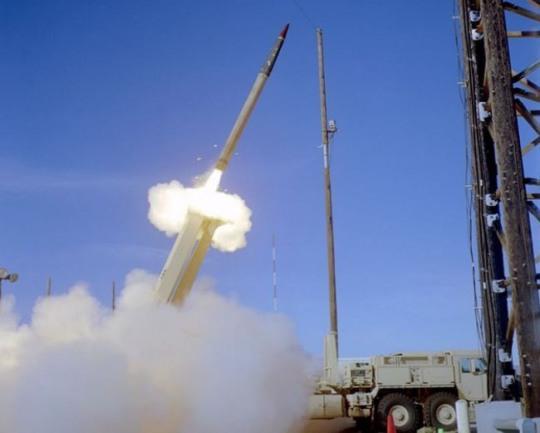
[THE INVESTOR] With Beijing’s rebuke showing little signs of abating over the U.S.’ envisioned THAAD stationing here, concerns are intensifying that China may take retaliatory steps that may take a substantial toll on the South Korean economy.
Following last announcement on July 8, Chinese Foreign Minister Wang Yi and other officials have reacted with sharp criticism, urging South Korea and the U.S. to shelve the plan. Official media churned out editorials and articles calling for military action and economic countermeasures possibly together with Russia.
President Park Geun-hye on July 11 sought to defend Seoul’s decision, calling it a “matter of survival” and a “presidential duty to protect the people and the nation.”
“(The deployed THAAD) would not be directed at a third party nation nor intrude upon its security interests,” she said during a meeting of senior presidential secretaries at Cheong Wa Dae.
Foreign Minister Yun Byung-se, for his part, said the ministry has been and will be continuing communications with China and Russia to promote their understanding.
“To China and Russia, we have emphasized that the deployment was being considered from the aspect of exercising our right to self-defense in light of North Korea’s expanding nuclear and ballistic missile programs,” he said at a session of the parliamentary foreign affairs and unification committee.
“We will take all necessary measures going forward to counter the threats.”
On Saturday, China’s state-backed Global Times suggested a cutoff of transactions with businesses involved in the deployment of the Terminal High Altitude Area Defense system and an import embargo on their products, as well as a travel ban on politicians who advocate the decision.
On the military front, the newspaper said Beijing should formulate a solution to minimize threats that may be posed by the assets, such as technical disturbances and directing its missiles toward the battery.
It also raised the need for Beijing to “reevaluate the long-term impact” of sanctions on North Korea because the THAAD system would tip the regional strategic balance -- a veiled guidance that China would not need to squeeze its isolated, impoverished neighbor as much now.
Seoul officials and experts anticipate that China will likely take some tit-for-tat steps given past patterns and level of its resistance. Yet the consequences may be bigger from souring public sentiment there even if no official measure is put in place, which could result in a drastic fall in the sales of Korean goods and cultural products and the number of Chinese tourists here.
Cheong Seong-chang, chief of unification strategy at the Sejong Institute, mapped out four scenarios of Chinese backlash: a plunge in Chinese travelers; a blow to the culture content industry in China due to the freeze of the Korean Wave; a boycott against Korean products; and other “invisible” disadvantages for Korean firms in China such as from tightened regulations.
“They would probably be some kind of retaliation, not right now but once the deployment is complete. And it doesn’t necessarily have to come from the government -- there is much to take a hit from in the private sector which can also go unnoticed,” a senior Foreign Ministry official said, requesting anonymity due to the sensitivity of the matter.
China is not new to economic retaliation. In 2000, Seoul jacked up its tariff more than tenfold on garlic imports from China as part of its special safeguard measure aimed at protecting Korean farming families. Beijing shoot back, imposing an embargo on Korean exports of mobile phones and polyethylene totaling $500 million, prompting Seoul to lift the duty increase shortly.
Such a trade dispute is much less likely to unfold again given that China is now a member of the World Trade Organization, which applies strict rules on export restrictions.
Yet China has taken similar steps since, barring the exports of rare earth minerals to Japan at the height of its territorial rows in the East China Sea in 2010 on reasons of “protecting natural resources” enshrined in the WTO guidelines. Later that year, Beijing banned imports of Norwegian salmon after the Scandinavian country gave a Nobel Peace Prize to jailed Chinese dissident Liu Xiaobo.
“It is possible that China would levy economic retaliatory sanctions against us but now is time for us to speak in a united voice,” another Seoul diplomat said. “Our logic for stationing THAAD, which is the defense of national security and public safety, is a lot greater than not doing so for the sake of Chinese concerns.”


![[World Class] HUFS bets on Songdo, AI to redefine what a global university can do](https://wimg.heraldcorp.com/news/cms/2026/10/18/news-p.v1.20260930.7e4dbeacfc1d4d16848c0e2a441c04e6_R.jpg?type=h&h=120)
