

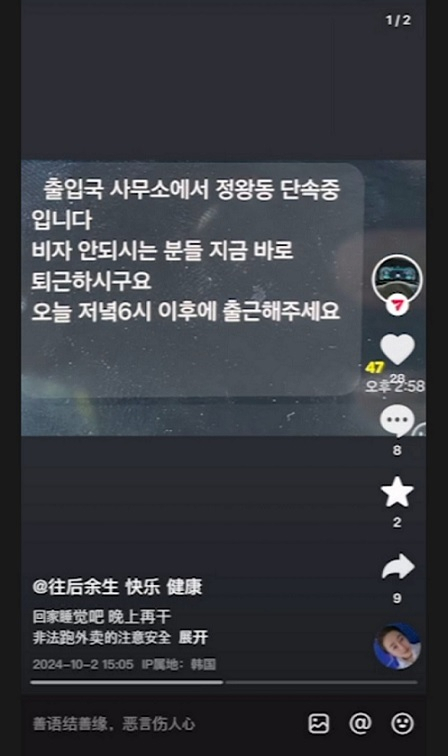
A post on Douyin, a Chinese equivalent to TikTok, has a screenshot of a text message written in Korean: “The immigration office is cracking down in Jeongwang-dong. Those without valid visas, please clock out immediately and start your shift after 6 p.m.”
Beneath the message, a photo shows a man reflected in the side mirror of a motorcycle. His caption in Chinese reads, “Let’s go home and get some sleep until then.” The day is Oct. 12, and it is just past 3 p.m.
Choi, a Korean delivery worker in his 30s, could understand immediately what was going on, despite the mix of Korean and Chinese: A Chinese delivery worker working illegally was warning other Chinese workers about ongoing immigration crackdowns, with their recruitment agency not just aware of the visa issues of some of their workers but actively supporting them working illegally.
In South Korea’s delivery scene recently, the number of foreign delivery workers without appropriate visas has increased markedly. The Douyin message reveals how this has been possible: eople working illegally are sharing work-related information on social media, including details about agencies hiring foreign drivers without valid visas and tips on the locations of police crackdowns.
Not just Choi, but several other people involved in the local delivery industry confirmed this in conversations with The Korea Herald.
To work as a delivery driver here, a foreign national must hold an F-2, F-5 or F-6 visa.
However, those without valid visas are slipping into the delivery gig economy, as the flexible, task-based nature of delivery work makes it easier for individuals to secure jobs without proper documentation. For instance, international students seek extra income through part-time delivery work, despite their student visa not allowing it.
Han, a 41-year-old delivery driver who is Korean and delivers to addresses around Wangsimni Station, Seongdong-gu, said many of his illegal counterparts are working under borrowed Korean identities. Once one passes the delivery driver registration process, they rarely need to show their ID to handle orders.
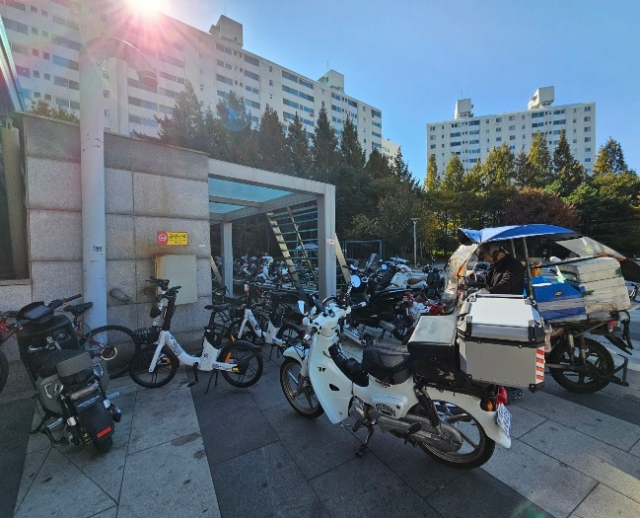
“They paid around 300,000 won ($213) to brokers for the names,” he said.
For Chinese nationals in particular, country-specific platforms like Douyin act can connect them to delivery jobs in Korea.
“They (foreign delivery drivers) introduce jobs to each other there. Also, some Korean officials at delivery agencies illegally recruit them through social media,” said Korean worker Cho.
Some of them upload pictures showing their delivery records and daily earnings, he said. “It‘s shocking to see them taking selfies and videos to share online while working illegally here,” he added.
Han, the Wangsimni area delivery driver, said while some delivery drivers working illegally register with major food delivery platforms like Baedal Minjok with borrowed Korean identities, there are also small delivery agencies that prefer drivers working illegally.
“It’s because they typically work for lower wages than Korean riders and are more likely to continue working in bad weather like rain or snow,” he said.
He said small delivery agencies located in areas with large foreign populations, such as Yeongdeungpo-gu in Seoul, Bupyeong-gu in Incheon and Yeongtong-gu in Suwon, are likely to have a higher proportion of foreign delivery drivers, many of whom he suspected would be working illegally.
From January to June this year, a total of 150 foreign national workers were caught illegally working in the local delivery and courier industry, Justice Ministry data shows, more than double the 71 detected during the same period last year.
In response to the rising competition from foreign delivery drivers working illegally, some Korean drivers have been trying to report them directly to the police.
On the country‘s largest online forum platform for delivery workers, World of Delivery, a section called “Illegal Foreign Worker Talk” is filled with posts reporting sightings of foreign delivery drivers allegedly working unregistered across the country.
Some users there shared guides on how to report them to the police, saying “The chances of catching illegal delivery workers increase when they are picking up ordered food, compared to when they are on the move.”
According to officials from the Ministry of Justice, should the police receive such a report about a foreign national potentially involved in unregistered employment, they refer the case to the local immigration office.
Wu, a 39-year-old Chinese delivery driver who is working with a valid visa, said the rise of delivery drivers working illegally is affecting him negatively.
“It’s wrong to assume that all foreign delivery workers are illegal,” he said, noting that he is often mistakenly suspected as one.
”The weak punishment for local business owners who overlook illegal employment is also a big problem,” he stressed.
A mismatch between supply and demand in the local delivery job market may be one of the underlying problems, but the authorities need to act more proactively to deal with unqualified delivery workers, experts said.
“During the COVID-19 pandemic, the domestic delivery market grew rapidly, leading to a shortage of delivery workers. At the same time, rising delivery driver commissions prompted delivery firms to seek workers who were willing to accept lower wages,” said Choi Jae-won, a professor at the Korea Road Traffic Authority.
He suspected that many delivery drivers working without permission from immigration could also be driving without proper insurance or even a local drivers license.
“In such cases, when an accident occurs, it becomes difficult to fully compensate the victims for their damages. The government needs to strengthen enforcement against foreign nationals working in the delivery industry,” he stressed.
cjh@heraldcorp.com