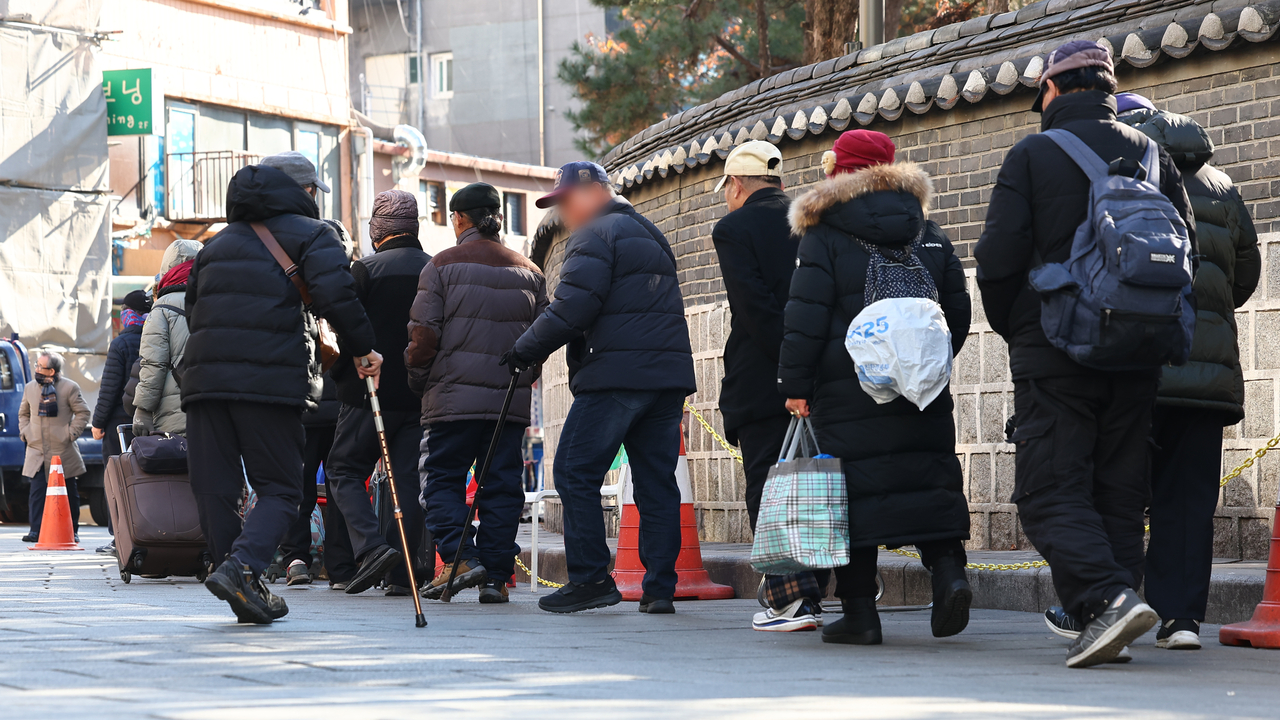
South Korea has officially become a “super-aged” society, with the total ratio of its population aged 65 and above surpassing 20 percent, according to the Ministry of Interior and Safety on Tuesday.
The number of Koreans aged 65 or older stood at 10.24 million, accounting for 20 percent of the country’s total population, which currently stands at 51.22 million.
According to the United Nations, a super-aged society is one in which more than 20 percent of the population is 65 or older. Those over 14 percent and 7 percent are defined as aged societies and aging societies, respectively.
According to the Interior Ministry, there were more women than men among those aged 65 and older. Of the whole population, 17.83 percent of men and 22.15 percent of women are senior citizens, indicating a 4.32 percentage point difference.
By region, 17.70 percent of the Greater Seoul region’s population were 65 and above, while the figure was 22.38 percent in other regions, indicating a higher proportion of senior citizens residing outside the capital area due to younger people moving out of rural areas into the cities.
Among individual provinces, South Jeolla Province saw the highest proportion of residents aged 65 and above at 27.18 percent, followed by North Gyeongsang Province at 26 percent, Gangwon Province at 25.33 percent and North Jeolla Province at 25.23 percent. The self-governing city of Sejong saw the lowest share at 11.57 percent.
In the capital city of Seoul, seniors accounted for 19.41 percent of the total population.
Based on the recent numbers, a ministry official said in a press release that the government urgently needs to establish a “population-focused ministry” tasked with enacting “fundamental and systematic response measures” to address the rapidly aging population. The official was referring to the government’s previous plans to launch a new ministry regarding population strategies to address its demographic crisis.
Korea has reached super-aged society status ahead of expectations.
On July 10, 2024, the number of people aged 65 and above surpassed 10 million, leading the Interior Ministry to revise its forecast and predict that Korea would become a super-aged society by early 2025. Statistics Korea had also projected this milestone for 2025.
Since 2008, when those aged 65 and above numbered 4.94 million, accounting for 10.02 percent of the total population, this age group has steadily increased. In 2019, the ratio surpassed 15 percent, reaching 19.05 percent by January this year, with 9.77 million individuals in this age group.
The number of registered residents aged 65 and above has also risen from 4.94 million in March 2008 to 8.32 million in July 2020 and 9.26 million by December 2022.
lee.jungjoo@heraldcorp.com