
College entrance exam weighs on students, parents, even exam writers
Park Jae-heung, a senior at Shinjang High School in Hanam, Gyeonggi Province, was hospitalized with acute pancreatitis three days before she took the state-administered college entrance exam on Thursday. Though she suffered from pain and a high fever after surgery, she made up her mind to take the exam which could play a decisive role in what university she attends and career she pursues.
This year, over 690,000 students took the nine-hour College Scholastic Ability Test, or “suneung.” Those who score high in the test have a good chance of advancing to prestigious schools, while the rest will find spots in less respected schools or choose to take the exam again next year. Of the 693,634 test takers, high school students made up about 76 percent, while 21 percent were trying their luck again.
“Last year, I got so nervous and had stomachache during the test,” said 19-year-old Lee Young-jae.
“The most important thing before the exam is to check my stomach condition and go over the key points I have studied.”
Some students remained calm on exam day.
“I feel okay today, I hope I can perform as much as I have studied,” said Lee Hee-ra, 19, who was the first to show up at Imae High School in Seongnam, Gyeonggi Province.
“I told my girl this morning that it would be great if she could do just as well as she has studied,” said her mother Seol Ju-yeon, 50.
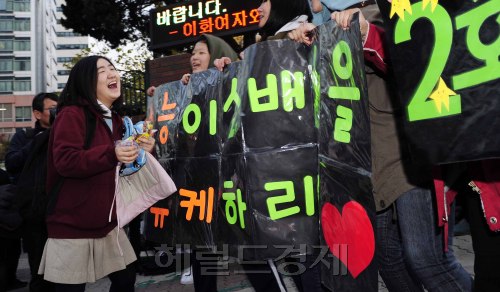
Junior students cheer for their seniors on their way to take the College Scholastic Ability Test at Ewha Girl’s Foreign Language High School in Seoul on Thursday. (Park Hae-mook/The Korea Herald)
This “suneung” day, the government rescheduled working hours, airplanes and military jets were grounded, and live-fire military drills were suspended near test sites during listening tests. Government offices and companies advised their employees to arrive at work an hour later at 10 a.m. and the stock market opened an hour later to help ease morning rush hour traffic so students could arrive at test sites in time. Construction work was also halted during Korean and English listening test hours.
The exam stress is tough not only for students, but also for exam authors, who spent a month confined to an undisclosed condominium in Gangwon Province. They spent 32 days preparing exam questions and checking answers under the supervision of the Korea Institute for Curriculum and Evaluation which oversees the CSAT, all without contact with the outside.
About 690 exam writers, review staff and security guards were set free to go home around 5:30 p.m. Thursday after the last session of the test started, said Park Nam-hwa, assistant manager in charge of external affairs at KICE.
Unfortunately two days before their scheduled finish, a 55-year-old high school teacher, who was one of the 307 exam authors, died, presumably of a heart attack, the Education Ministry said.
The rigidity of the test is felt in tight rules to prevent cheating. Students are not allowed to carry any electronic devices. Metal detectors screen them before they enter test rooms. Students who wish to go to the restroom during the test are escorted by a staff worker after being screened by metal detectors for electronic devices.
One student was caught with a mobile phone and micro-size wireless earphones before the test began.
Despite all the stress and time and energy consumed for the one-day test every year, Korean students have taken the CSAT since 1993 when its format was changed from the previous rigorous college entrance exam. It has been blamed as the culprit behind overheated private tutoring that burdens many parents, with private education expenses reaching about 21 trillion won ($19 billion) in total last year, according to the Education Ministry.
Now the stressful test seems to have settled as an annual rite.
“The test has become a rite of passage that Koreans have to undergo to become an adult,” said Park Jumi, a 27-year-old teacher for seniors at Janggok High School in Siheung, Gyeonggi Province.
The test results will come out on Nov. 30.
The early application process will be wrapped up on Dec. 11 after the test scores come out and the regular application process will take place from Dec. 22 to 28.
By Lee Woo-young (wylee@heraldm.com)


![[World Class] HUFS bets on Songdo, AI to redefine what a global university can do](https://wimg.heraldcorp.com/news/cms/2026/10/18/news-p.v1.20260930.7e4dbeacfc1d4d16848c0e2a441c04e6_R.jpg?type=h&h=120)
