

Japan’s Foreign Ministry has deleted its description of South Korea as an “important neighbor sharing the basic values of liberty, democracy and market economy” from its website, a possible signal of discontent with Seoul.
The website now describes South Korea as the “most important neighboring country,” an expression that Korean critics say has lessened the value Tokyo attaches to their country.
The change in the description came amid ongoing diplomatic tension due to Japan’s repeated claim to South Korea’s easternmost islets of Dokdo, failure to fully atone for its wartime atrocities, including its sexual enslavement of Korean women, and factual distortions in history books.
The change was anticipated, as Japanese Prime Minister Shinzo Abe simply referred to South Korea as the most important neighbor without further elaboration in his policy address to the nation in February.
In a 2013 speech, Abe called South Korea the most important neighbor, and said the two countries shared the basic values of liberty and democracy, and the same interests. In 2014, he described South Korea as the most important neighbor, and said they shared basic values and interests.
During her speech marking the 96th anniversary of the March 1 Independence Movement, President Park Geun-hye described Japan as an “important neighbor sharing values of liberal democracy and a market economy, and jointly pursuing peace and prosperity in Northeast Asia.”
Observers said that Tokyo might have altered its previous description to express its discomfort over the diplomatic impasse between the two nations. An article in Japan’s Asahi Shimbun noted that a “change of Tokyo’s perception” of Seoul appeared to have driven it to change the description.
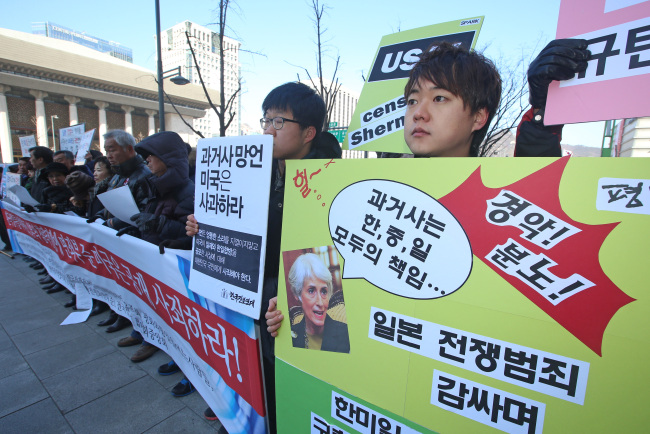
The deletion also came amid widespread furor in Seoul over U.S. Under Secretary of State for Political Affairs Wendy Sherman’s recent remarks in Washington that suggested South Korea and China were to blame in deteriorating relations with Japan over history issues. The unusual remarks by Sherman stoked speculation that Washington has begun to less discreetly urge Seoul to mend the fences with Japan.
Since President Park Geun-hye took office in February 2013, she has not met Abe for a bilateral summit discussion, although the two met at a trilateral summit brokered by U.S. President Barack Obama last year.
Abe has repeatedly expressed his wish to hold a bilateral summit with Park. But Park has rejected the offers as Abe’s apparently revisionist historical views have seriously damaged public sentiment in South Korea, and there has been little progress over the issue of Japan’s wartime sexual slavery.
The two sides appeared to have moved toward practical cooperation on security as they agreed last December to sign a trilateral military information-sharing arrangement with the U.S. But diplomatic friction flared up again after Japan continued to claim sovereignty over Dokdo and refused Seoul’s demands to properly address the sexual slavery issue.
By Song Sang-ho ()
koreaherald@heraldcorp.com


![[World Class] HUFS bets on Songdo, AI to redefine what a global university can do](https://wimg.heraldcorp.com/news/cms/2026/10/18/news-p.v1.20260930.7e4dbeacfc1d4d16848c0e2a441c04e6_R.jpg?type=h&h=120)
