

With an unusually long holiday week ahead of the May 9 election, major presidential candidates are exerting efforts to increase voter turnout, striving to motivate their supporters to go to the polls.
One of their biggest opportunities is the two-day early voting period to take place from Thursday to Friday, the participation rate and demographic composition of which will be seen as a gauge for the final election result next week.
The most enthusiastic advocate of early voting was front-runner Moon Jae-in of the Democratic Party of Korea, who counts on liberal-leaning supporters in their 20-40s who are usually less likely to vote. A strong turnout would also strengthen his mandate if he is elected.
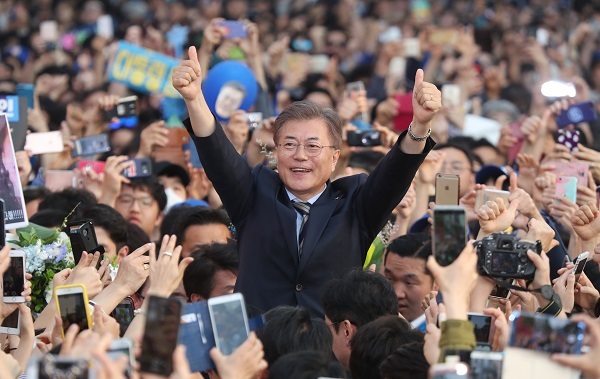
“(Even) Choi Soon-sil, the central figure in the state corruption scandal, will be casting her ballot at the detention center tomorrow,” Moon’s chief spokesperson Rep. Yoo Eun-hae said at a briefing Monday.
The party has activated a special campaign titled “Vote” to encourage the public to exercise their political rights, promoting the early voting system to holiday travelers and young voters.
“It is the youths that suffered the most under ‘Hell Joseon’ and it is they who will turn the system upside down and complete the candlelight revolution,” Yoo said. Hell Joseon is an online buzzword used mostly by young people to describe South Korea as a bad place to live.
“The way for young people to change the world is to cast their votes on May 4.”
The strategy of the other candidates, on the other hand, is to appeal to undecided voters. While Ahn Cheol-soo of the People’s Party strove to win over centrist-conservative voters, hard-line conservative Hong Joon-pyo of the Liberty Korea Party focused on reaching out to senior citizens aged 50 or more.
“Our key point is to encourage those who are hesitant toward voting and to make them visit polling stations,” said Ahn’s chief strategist Kim Song-sik.
The early voting system, which makes it possible for eligible voters to cast their ballot a few days in advance of the actual election day, was first introduced in 2013, shortly after the 2012 presidential election.
Of the 58 percent who voted in the April 13 general election last year, 12.19 percent visited polls in advance.
The leading liberal party’s target for early voting turnout is 25 percent, while pundits mostly expect it to fall between 14 and 15 percent.
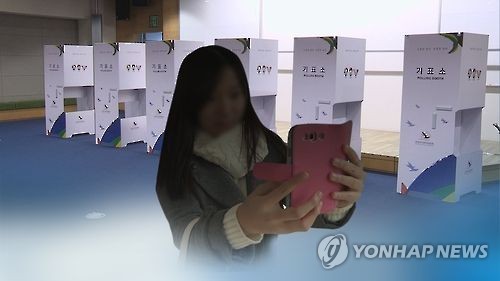
On Saturday, the National Election Commission will announce the regional turnout, based on which election camps may refine their campaign strategies during the last few days.
Also, the alleviated election regulations -- allowing voters to express their likes and dislikes for specific candidates and parties -- is expected to exert influence on undecided voters.
According to the revised Public Officials Election Act, effectuated in January this year, voters may share selfies on the internet to show they voted or make hand gestures to support or disapprove of a candidate. The given law previously banned expressions such as thumb-raising or making Vs, classifying them as electioneering for the candidate of the corresponding number of digits held up.
They may also take photographs in front of candidates’ posters. Photographs of ballots or polling stations, however, will still be banned.
By Bae Hyun-jung ()
koreaherald@heraldcorp.com

![[World Class] HUFS bets on Songdo, AI to redefine what a global university can do](https://wimg.heraldcorp.com/news/cms/2026/10/18/news-p.v1.20260930.7e4dbeacfc1d4d16848c0e2a441c04e6_R.jpg?type=h&h=120)
