The opposition bloc Tuesday looked to capitalize on their majority in the parliament and their newfound public support, as they pushed for legislation-led reforms on a series of issues encompassing the prosecution, media, civil servants and financial sector.
Rep. Woo Sang-ho, the floor leader of the main opposition Democratic Party of Korea, said during a party meeting that it would hold regular discussions with civic society on what it calls “legislative reform.”
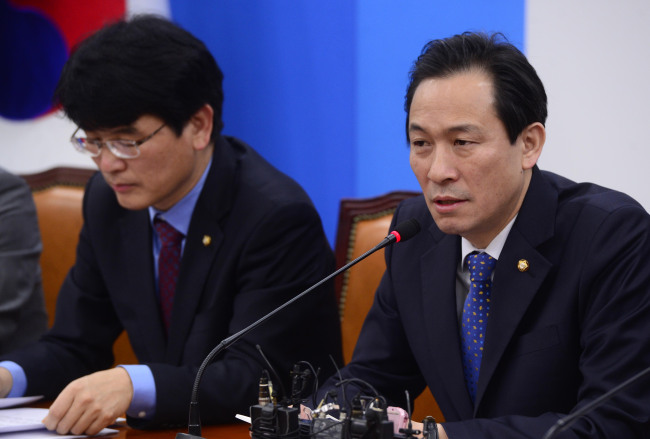
“In order for the reform to take place at the February session of the National Assembly, we must collect opinions from civic society within January,” he said.
Rep. Kim Song-sik, chief policymaker of the minor opposition People’s Party, also stressed the necessity of the passage of reform-related bills to “eradicate residual harmful effects of the Park Geun-hye administration.”
The legislative reform refers to the passage of laws for agendas that have been jointly pursued by the opposition bloc, but have been thwarted by the ruling Saenuri Party’s status as the majority party.
A mass defection of 29 nonmainstream Saenuri lawmakers has shrunk the ruling party down to 99 members. Falling below the 100-member mark is of particular significance, as the Korean law stipulates that at least one-third of the 300-member parliament is required to hinder a legislative process via a filibuster.
Opposition by one-third of the parliament is also necessary to foil an amendment of the Constitutional Law.
The opposition bloc can now potentially bypass the law to directly push through the legislative process, as the law only requires consent of 60 percent -- or 180 -- of the lawmakers. This means if the opposition can get the Saenuri defectors to fall in line with their reform drive, any objection by those in Saenuri who are pro-Park would not be a factor.
The opposition party leaders have already extended a hand to the conservative opposition bloc to partake in their reform.
Among the legislations expected to be pursued are bills to amend the anti-terrorism bill, which is disputed for infringing people’s privacy, install an investigative body on corrupt civil servants, extend the operation of the special committee on investigating the 2014 sinking of ferry Sewol, and ban the adoption of the controversial state-authored textbook.
“Obviously we need to negotiate within the political circles but if that fails, isn’t it time that the principal of majority should take effect?” said Park Wan-joo, the deputy floor leader of the Democratic Party, implying that they should capitalize on their majority for the legislation.
In addition to the parliamentary majority, nationwide discontent toward the president is also expected to propel the reform drive.
President Park’s alleged involvement in the recent corruption and influence-peddling surrounding her confidante Choi Soon-sil has led to multiple candlelight vigils -- with up to 2.3 million participants at one point -- and the National Assembly passing a motion to impeach her.
The Constitutional Court is currently deliberating the case.
minsikyoon@heraldcorp.com