
Lee seeks ‘structural majority’ by winning over centrists and moderate conservatives
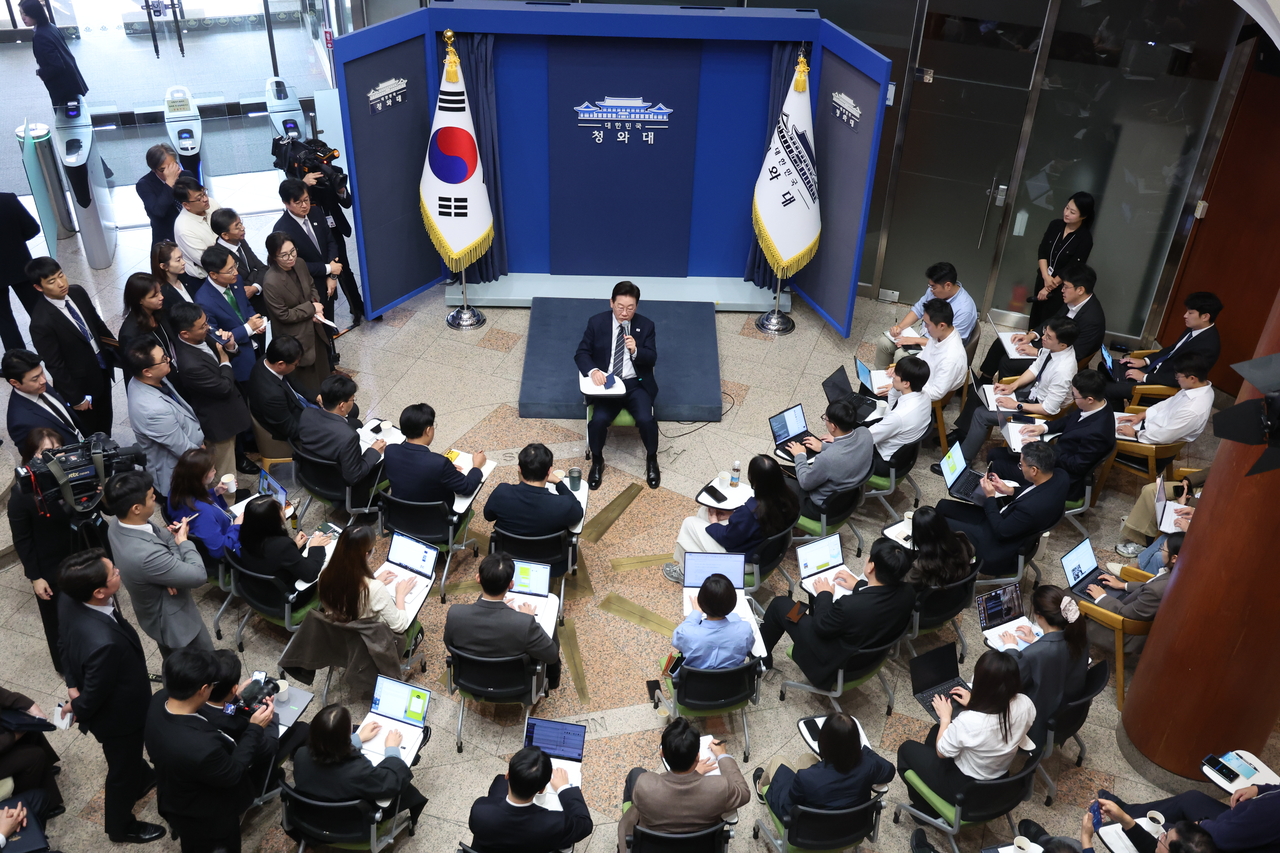
President Lee Jae Myung on Monday defended his growing use of social media as a political "lifeline" and said he plans to expand direct communication with the public while exploring more face-to-face exchanges with citizens.
Lee said his increased activity on X, formerly Twitter, and his impromptu meeting with reporters reflected concerns that he may have grown too detached from realities on the ground and that his administration's intentions were not getting through to the public.
The self-reflection came as Lee acknowledged shortcomings in his handling of reforms, including changes to real estate tax policies, while questioning whether he had done enough to persuade and empathize with those who stood to lose from the changes.
"I intend to communicate even more with the public going forward," Lee said during an impromptu informal meeting at the Cheong Wa Dae press center. "I think I should take this opportunity to expand my communication channels."
His remarks came amid scrutiny of his increasingly frequent posts on X, which he defended as essential to maintaining direct contact with citizens rather than a departure from presidential decorum.
"Is a president supposed to be some great, solemn figure?" he asked. "A president is simply the leading representative among public servants who serve the people."
Lee credited social media with helping him withstand political attacks and ultimately reach the presidency.
"Would I have become president without social media? Could I have withstood the barrage of malicious attacks?" he asked.
While acknowledging that text-based platforms such as X could make his remarks sound sharper than intended, Lee said he was looking into ways to engage with citizens more directly in person.
Lee also said the government was considering changes to his town hall meetings, which have taken him to cities across the country to hear residents' concerns, to make the gatherings less formal and encourage more candid exchanges.
Lee's biggest obstacle? Himself, he says
Asked about the biggest obstacle facing his administration, Lee pointed to his own shortcomings in preparing for and managing its reform agenda.
"My lack of preparation or shortcomings in managing the process may have been the biggest cause," Lee said. "I've also been reflecting on whether I was overly confident in carrying out reforms."
Lee said he may have been too focused on the belief that his administration was pursuing necessary reforms that would ultimately benefit the public, expecting people to endure difficulties in the meantime.
While acknowledging that his supporters had questioned what exactly his administration had done wrong, he said the more important issue was whether he had shown enough "persuasion, empathy and compassion" toward those who stood to lose from the changes he was making.
Explaining his frequent use of X, Lee said, "One reason I've been using Twitter so much is to convey our sincerity."
"This impromptu meeting with reporters is also part of my reflection on whether I've grown too distant from what's happening on the ground. I've been reflecting deeply on whether our sincerity is getting through," Lee said. "The biggest cause lies with me," he added.
Lee also signaled that he may slow the pace of his reform drive, while stressing that his administration remained committed to carrying out its policy agenda.
"I believe the Republic of Korea's society has made more progress than we had initially planned," Lee said, referring to South Korea by its official name.
But Lee acknowledged criticism that his administration was "trying to do too much at once" and that "the pace of reforms may need to be adjusted."
"When there's just one reform, (those affected) may see it as necessary. But when there's a second, they become more reluctant, and by the third, they may start asking, 'Do you really have to go this far?'" he said.
Lee pointed to the June 3 local elections as a possible turning point in public sentiment toward his administration.
"The local elections seem to be a turning point. Since then, for various reasons, I'm told there are more people who think we're doing a poor job than a good one, so perhaps we need to slow down," Lee said.
"But at the same time, we intend to carry out what we've committed to do, and what our society must do, at the right time and through the right methods and processes," he added.
Lee seeks broader majority
Lee also rejected speculation that his call for a "structural majority" signaled plans for a political realignment, an interpretation advanced by political commentators including former Health Minister Rhyu Si-min.
Rhyu, a prominent progressive commentator, had warned in July that Lee appeared to be seeking to reshape South Korea's political landscape rather than simply broaden support for the Democratic Party of Korea, potentially undermining the progressive camp.
Lee argued that the reform-oriented governing camp would remain a "structural minority" if it relied solely on its traditional supporters, as centrists and moderate conservatives could otherwise align with the opposition, leaving the progressive bloc without sufficient support to retain power.
"If we only unite among ourselves, we will ultimately remain a structural minority," Lee said. “We need to become a structural majority by broadening our reach to include centrists and reasonable conservatives."
Lee stressed that his vision of a structural majority meant winning the support of a broader segment of the public across ideological lines, rather than recruiting opposition lawmakers or reshaping alliances in the National Assembly.
Lee dismissed such political maneuvering as outdated, arguing that bringing in a handful of opposition lawmakers would do little to change the underlying political landscape and could instead provoke public backlash.
"Even if you bring in a few lawmakers from the other side, would that change the political structure? It wouldn't," he said.
Lee says police appointment nears
Lee also acknowledged delays in filling key government positions, including those of justice minister and national police commissioner, describing personnel appointments as "one of the most difficult parts" of governing.
On the delayed appointment of a police commissioner, Lee pointed to personnel disruptions following the martial law declaration by ousted President Yoon Suk Yeol on Dec, 3, 2025, and subsequent efforts to hold those involved accountable.
"Personnel management has been significantly distorted," Lee said. "With the martial law crisis and the process of holding those responsible accountable, the pool of available candidates has become rather limited."
Lee signaled that the appointment of a new national police commissioner could be finalized soon.
"It will be resolved soon," he said.
He acknowledged, however, that the administration still faced challenges in filling other key vacancies.
"We also need to make appointments, including the head of the National Tax Service and the justice minister," Lee added. "I understand that the process may appear to be taking a long time, but we are doing our best to find the right people for these positions."
dagyumji@heraldcorp.com