
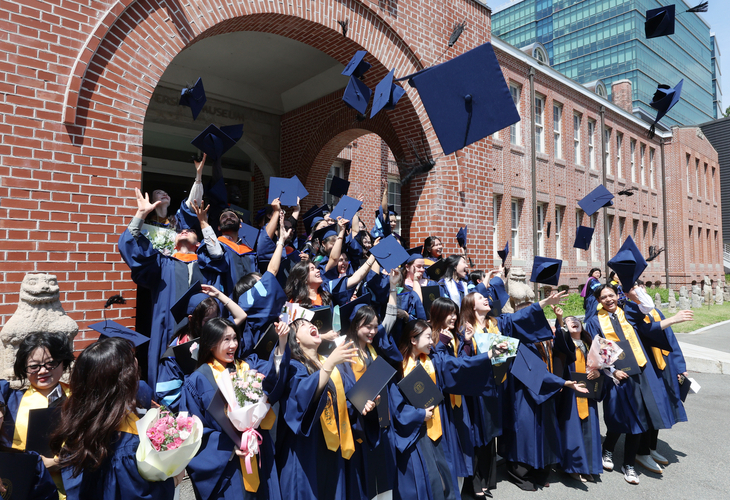
The number of foreign nationals who entered South Korea for study or training surpassed 500,000 for the first time last year, according to data released Thursday.
지난해 유학이나 연수를 목적으로 한국에 입국한 외국인 수가 처음으로 50만명을 넘어섰다고 목요일 발표된 자료에서 나타났다.
Of the 18.94 million foreign nationals who entered Korea last year, 505,410, or 2.7 percent, came for study or training, according to Korea Tourism Organization data obtained by Rep. Jin Sun-mee of the Democratic Party of Korea.
한국관광공사가 더불어민주당 진선미 의원에게 제출한 자료에 따르면, 지난해 한국에 입국한 외국인 1,894만명 가운데 유학이나 연수를 목적으로 입국한 외국인은 50만5,410명으로 전체의 2.7%를 차지했다.
Tourism accounted for the vast majority of arrivals, with 15.82 million visitors, or 83.5 percent, entering Korea for sightseeing. Another 143,076, or 0.8 percent, came for business purposes, while 73,303, or 0.4 percent, visited on official business.
입국 목적의 대부분은 관광으로, 지난해 1,582만명, 즉 전체의 83.5%가 이를 목적으로 한국에 입국했다. 사업을 목적으로 입국한 외국인은 14만3,076명(0.8%)이었으며, 공무를 목적으로 방문한 외국인은 7만3,303명(0.4%)이었다.
The number of foreign nationals entering Korea for study or training has risen sharply since the COVID-19 pandemic.
유학이나 연수를 목적으로 한국에 입국하는 외국인 수는 코로나19 팬데믹 이후 크게 증가했다.
Only 80,084 entered for such purposes in 2021, amid pandemic-era travel restrictions. The figure nearly doubled to 152,195 in 2022 before rising to 313,980 in 2023 and 435,129 in 2024. It exceeded 500,000 for the first time last year, representing a more than sixfold increase from 2021.
팬데믹 기간 여행 제한이 시행됐던 2021년에는 유학이나 연수를 목적으로 입국한 외국인이 8만84명에 불과했다. 2022년에는 15만2,195명으로 거의 두 배 증가했고, 2023년 31만3,980명, 2024년 43만5,129명으로 늘었다. 지난해에는 처음으로 50만명을 넘어 2021년보다 6배 이상 증가했다.
Jin’s office attributed the growth in part to the global popularity of Korean cultural content, including K-pop and Korean dramas, which it said has translated into greater interest in Korean-language study and degree programs in the country.
진 의원실은 이러한 증가의 배경으로 K팝과 한국 드라마 등 한국 문화 콘텐츠의 세계적인 인기를 일부 꼽았다. 한국 문화 콘텐츠의 인기가 한국어 학습과 국내 학위 과정에 대한 관심 증가로 이어졌다는 설명이다.
Across all purposes of travel, people in their 20s and 30s accounted for nearly half of foreign arrivals in Korea last year.
지난해 전체 입국 목적을 기준으로 보면 20대와 30대가 한국에 입국한 외국인의 절반에 가까운 비중을 차지했다.
Those in their 20s made up the largest group at 4.72 million, or 24.9 percent, followed by those in their 30s at 4.05 million, or 21.4 percent. Together, the two age groups accounted for 46.3 percent of all foreign arrivals.
20대가 472만명(24.9%)으로 가장 많았고, 30대가 405만명(21.4%)으로 뒤를 이었다. 두 연령대를 합하면 전체 외국인 입국자의 46.3%를 차지했다.
Visitors in their 40s accounted for 14.5 percent, followed by those aged 60 or older at 12 percent, those in their 50s at 11.6 percent and those aged 19 or younger at 9.1 percent.
40대는 14.5%를 차지했으며, 60세 이상이 12%, 50대가 11.6%, 19세 이하가 9.1%로 뒤를 이었다.
“The global spread of Korean cultural content is translating into demand for longer-term stays, including study and training, beyond short-term tourism,” Jin said.
진 의원은 “한국 문화 콘텐츠의 세계적인 확산이 단기 관광을 넘어 유학과 연수를 비롯한 장기 체류 수요로 이어지고 있다”고 말했다.
“Tailored policy support is needed to help foreign nationals who come to Korea for study and training successfully adjust to their local communities,” she added.
이어 “유학과 연수를 목적으로 한국을 찾은 외국인들이 지역사회에 성공적으로 적응할 수 있도록 맞춤형 정책 지원이 필요하다”고 덧붙였다.
Tip Words
1. surpass – 넘어서다
2. vast majority – 대부분
3. sightseeing – 관광
4. purpose – 목적
5. restriction – 제한
6. translated into – 이어지다
7. degree – 학위
8. account for – 차지하다
9. beyond – 넘어
10. tailored – 맞춤형
khnews@heraldcorp.com