Lee Jae Myung meets with Korean directors, actors and industry figures ahead of film summit in France, pledges to review tax break for film investors

President Lee Jae Myung sat down with Korean directors, actors and industry executives in southern France Monday ahead of an inaugural global summit on the film and television industry. The message he heard: Korea's film industry is in worse shape than its global reputation suggests.
The meeting, which took place at the Fondation Maeght in Saint-Paul-de-Vence, preceded the main program of the Lumiere Summit, a multinational gathering on the future of cinema that Lee co-chaired with French President Emmanuel Macron. Earlier that day, the two leaders had announced a joint fund under which each country will invest 500 million euros ($581 million) in film and television over five years starting from 2027.
Director Lee Chang-dong and actors Sul Kyung-gu and Jeon Do-yeon flew in from Venice to join, where their film "Possible Love" had premiered in competition at the Venice Film Festival a day before. Also present were director Jung July and actor Kim Do-yeon of "Dora," which screened at this year's Cannes Film Festival, along with Netflix Asia-Pacific content chief Kim Min-young.
The president has made the film industry a stated priority since taking office last year, raising the government's annual film support budget by more than 80 percent and twice rolling out discounted movie tickets to bring audiences back. On Monday, he told the group he would continue to back the industry so that more creators could get a chance, according to the presidential office.
Big commercial projects could be handled by global investors, but the government should step in for smaller local productions, he added. That would mean providing support for writers, backing for production and distribution, and funds to help independent and art films compete abroad, he said.
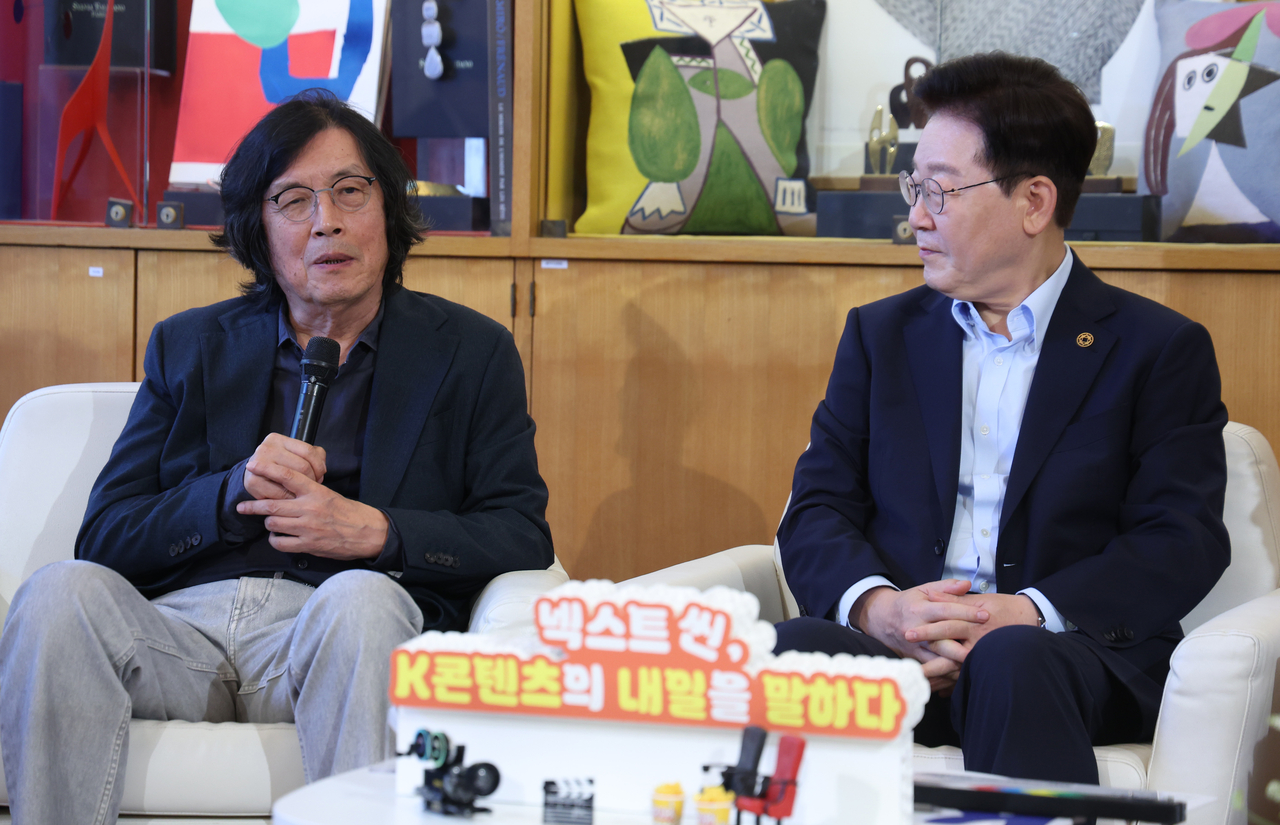
Lee Chang-dong, whose "Burning" won the critics' prize at Cannes in 2018, described an industry under strain. The auteur had earlier noted that "Possible Love," his first film in eight years, could not find investors at home before Netflix came on board. Korea's film industry may now rival France's in global stature, he said, but not in its underlying strength.
"On the surface it looks like we're enjoying the most spectacular results we've ever had," he said, according to Korean media at the scene. "But inside, a structural crisis is already under way."
Korea's film industry had one of its worst years on record in 2025 as financing dried up and audiences stayed home. Fewer than 20 films with budgets over 3 billion won ($2.2 million) went into production, down from around 100 a few years earlier, according to figures released by the Culture Ministry last September.
The market has been slower than most major territories to bounce back from pandemic-era setbacks: data from the Korean Film Council, the state agency that tracks box office figures, puts the country's box office revenue in 2024 at only 53 percent of 2019 levels, as opposed to 70 to 80 percent in the US and UK and close to 100 percent in France.
The numbers have somewhat improved this year, with first-half revenue up 42 percent from a year prior, but most of that gain came from the runaway success of a single film, the period drama "The King's Warden."
As a possible fix for the funding squeeze, director Lee pointed to France's SOFICA program, which gives private investors a tax break on money they put into film.
Under the initiative, anyone who invests 100 million won ($74,300) gets nearly half of it back in tax relief. That money is earmarked to support smaller films and first-time filmmakers. The program has helped finance some 3,500 films and TV works since 1985, according to France's national film agency, the CNC.
Jung, whose indie production "Dora" was co-produced by studios in Korea, France and Luxembourg, noted that smaller films were struggling to find investors. She also voiced concern about the threat artificial intelligence poses to creators and asked for a follow-up meeting on the issue, to which the president agreed.
Following the meeting, the president joined the summit's official luncheon hosted by Macron alongside culture ministers, industry executives and creators from around the world, the presidential office said.
moonkihoon@heraldcorp.com


![[Exclusive] Rescene eyes November comeback after breakout year](https://wimg.heraldcorp.com/news/cms/2026/09/08/news-p.v1.20260908.303dc8341b964b4f83739410a5791df6_R.jpg?type=h&h=120)