Renowned Korean designer turns to Kahlo for his 40th-anniversary collection, exploring pain, healing, power of cultural encounters
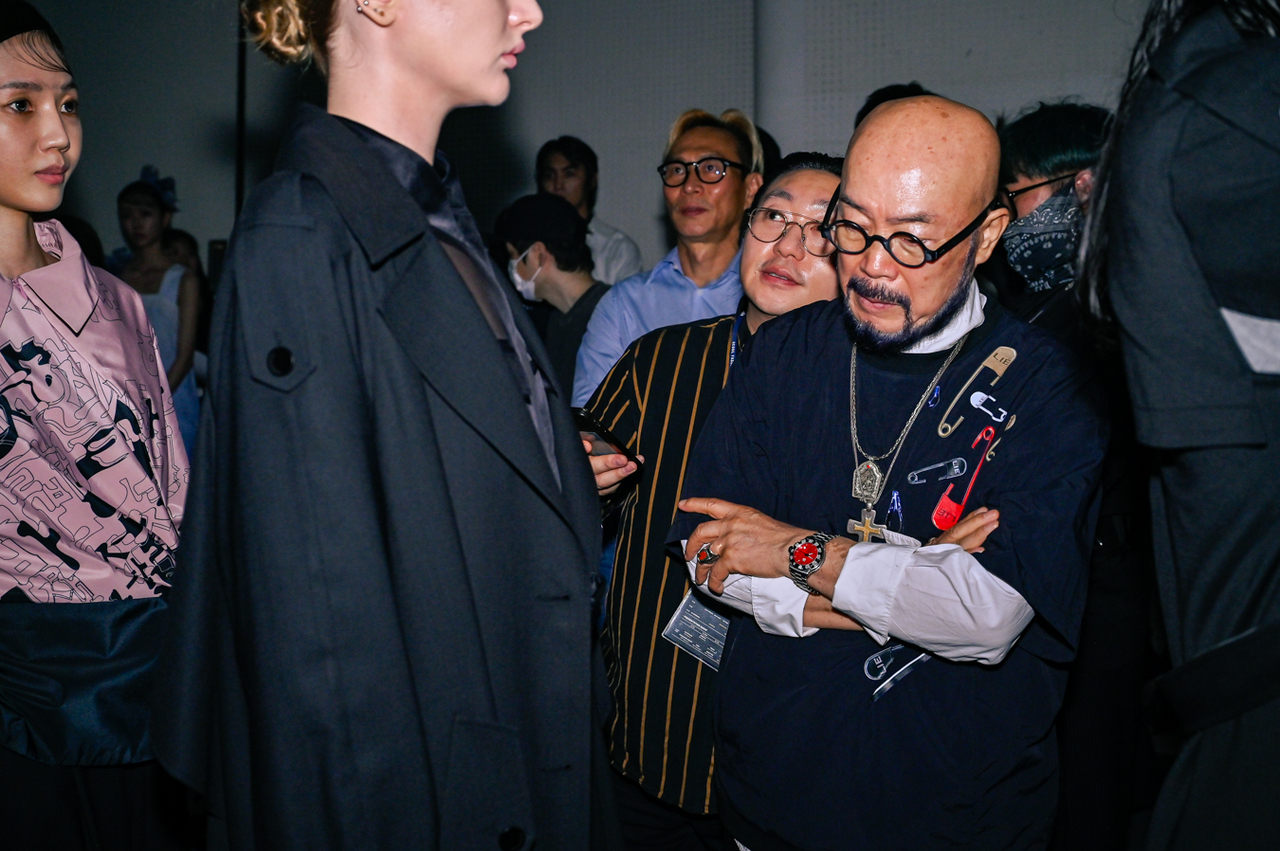
Fashion designer Lie Sang-bong has spent four decades bringing Korean cultural motifs to audiences overseas. For his 40th anniversary collection, however, he began somewhere else — with a Mexican artist whose work confronted pain head-on.
Frida Kahlo became the muse for Lie’s latest collection, shown Tuesday evening at Dongdaemun Design Plaza on the opening day of 2027 spring-summer Seoul Fashion Week. Behind the choice was a question that has stayed with him amid years of war and conflict: How do people heal from wounds that history leaves behind?
“War leaves wounds, and those wounds come back to individuals. Our own country fought a war and we are still talking about it today. If a war has already happened, the question becomes how we heal it,” the designer told The Korea Herald ahead of the show.
Lie first encountered Kahlo in a book about the artist some 30 years ago and never forgot her story.

Kahlo was impaled in a 1925 bus crash that fractured her spine in three places. During her recovery, she began painting from an easel positioned over her bed. Her physical and emotional suffering became central to her work, including self-portraits in which her body is depicted as fractured, pierced and bleeding.
What stayed with Lie was not simply Kahlo’s depiction of pain, but the way that pain evolved in her work.
“We try to hide our wounds. She revealed hers, acknowledged them and healed through that. Her paintings were brutal in her early stages as a painter, but later she painted herself with flowers. That sequence became the structure of this collection,” Lie said.
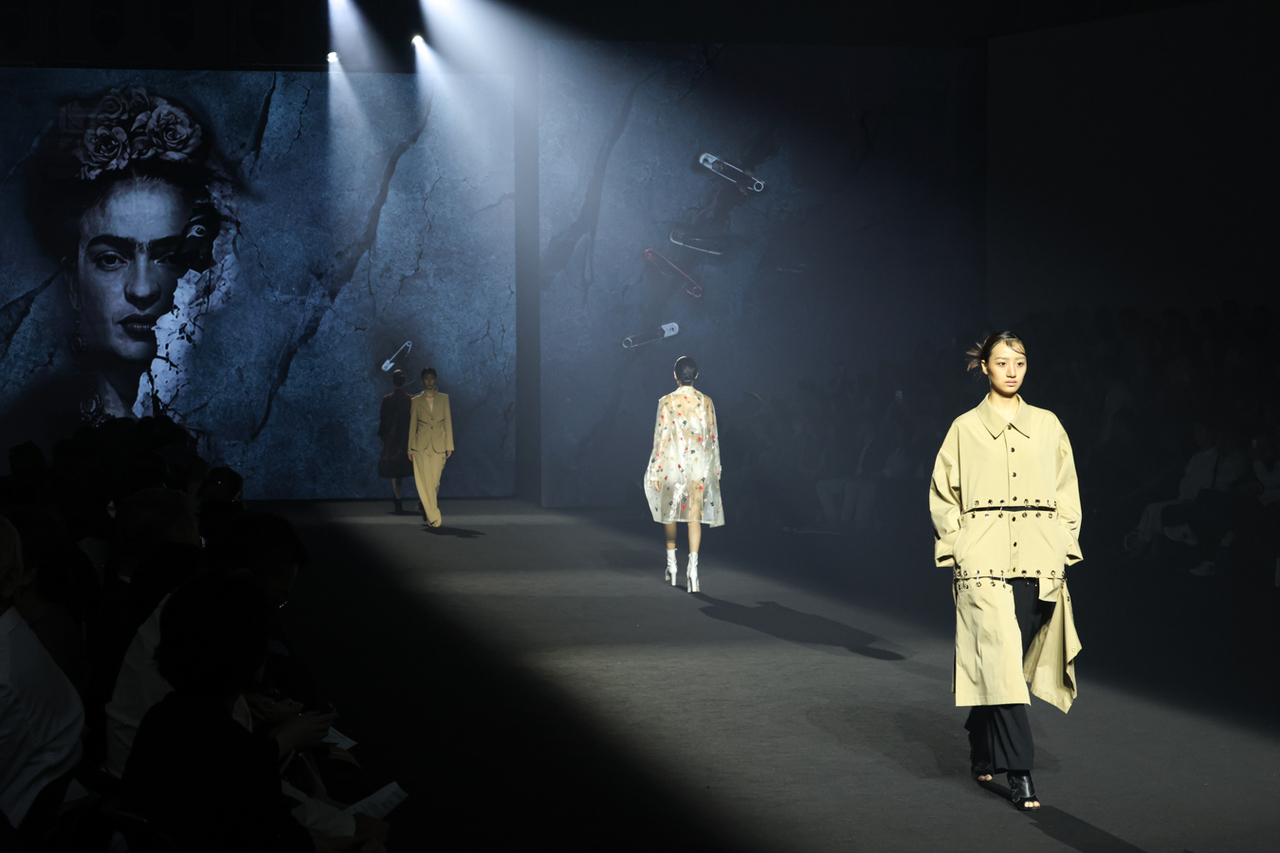
The runway followed that progression from wounds toward healing.
Tears became raindrops, printed in blue across the second quarter of the runway. Safety pins stood in for stitches, holding together a trench coat cut into three sections and rejoined at the seams. Small mirrors hung from the tops of garments, recalling the mirror Kahlo worked beneath while painting.
The show ended with flower crowns and a long floral dress worn with fabric drawn over the head, giving the collection its most hopeful imagery.
The emotional arc began before the clothes appeared. Traditional Korean musician Kim Jun-soo opened the show with a "gueum," a wordless vocal line in the register of a funeral cry. Lie wanted the audience to encounter the collection’s sense of pain through sound first.

Kahlo’s name, meanwhile, appeared on the clothes in Hangeul — a typically Lie Sang-bong gesture of placing Korean culture inside an international visual language.
“Mexicans will see this and learn that it is Hangeul. I always work our culture into the clothes this way,” he said.
Lie entered fashion in 1975 and launched his brand Lie Sangbong in 1985. He was the first Korean designer to stage runway shows in Paris and New York and currently chairs the Korea Fashion Designers Association.
His insistence on making Korean identity visible in his work was not always welcomed.
When he first put Hangeul on garments, his son, designer Lie Chung-chung, told him it was too literal. Others were more blunt.
“People around me asked if I was trying to go out of business, because at the time Korea itself was not well known and I was betting on Hangeul,” Lie said.
But the response in Paris made him wish he had gone further.
“After the show, the association in Paris (Federation de la Haute Couture et de la Mode) kept playing my collection. Watching that, I regretted it. I should have pushed harder. Culture has to be direct. If it is only imitated, no one knows what they are looking at,” he said.
He has continued to follow that philosophy, which he describes as staking a claim on culture before anyone else does.
At a 2023 show at Belvedere Palace in Vienna, for instance, Lie rendered the pattern of Gustav Klimt’s “The Kiss” in dancheong, the polychrome painting traditionally found on Korean temple eaves.
“Dancheong, Hangeul, those are what feel new to people abroad,” he said.

For the anniversary collection, he prepared about 70 looks, well above the roughly 40 looks typically presented on a Seoul runway. For Lie, a collection needs enough breadth to carry its story through to the end.
The choice of Kahlo and the use of Hangeul for her name distill that philosophy: one culture encountering another, with each changing how the other is seen.
“When cultures meet, there is power in it, and when another culture meets Korean culture, the way people from other cultures look at us changes too,” he said.
For Lie, that encounter is also central to what cultural preservation should mean.
“We say we are preserving our design heritage, but preservation ends there. It has to be pulled back out and made to fit the present,” he said.
yoohong@heraldcorp.com