Intellectual Property Minister Kim Yong-sun outlines monetization drive, technology police expansion and global K-brand safeguards
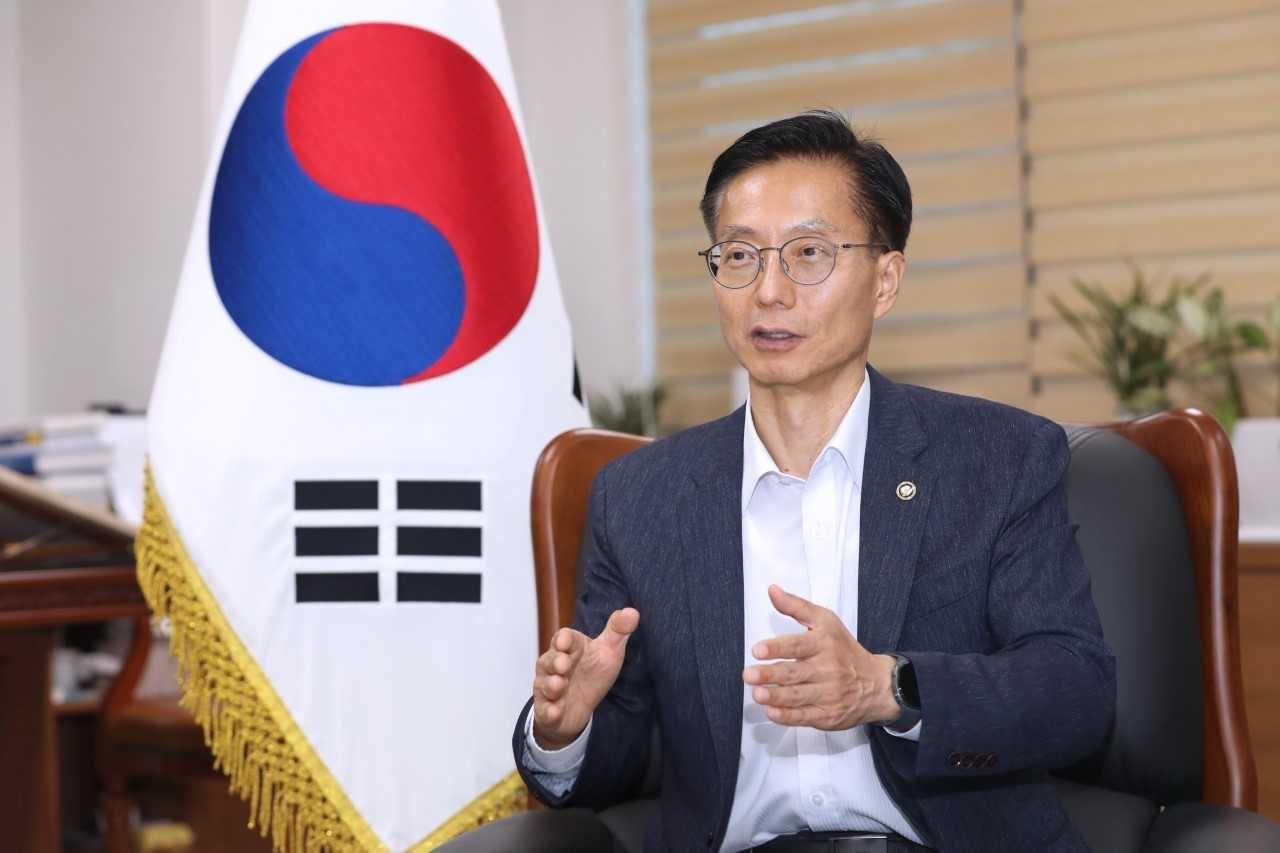
South Korea’s newly elevated intellectual property authority is seeking to turn patents and ideas into sources of revenue, moving beyond its traditional role of examining and registering intellectual property rights.
“The biggest change is that our role no longer ends with granting and protecting rights,” Intellectual Property Minister Kim Yong-sun said in an interview with The Korea Herald. “We are expanding it to help intellectual property generate revenue through transactions and commercialization.”
The elevation of the Korean Intellectual Property Office into the Ministry of Intellectual Property reflects the government’s decision to make IP a pillar of national growth, according to Kim, the inaugural ministry head.
His priority has been to strengthen the ministry’s authority to coordinate IP policy across government agencies. Previously fragmented policies are now being connected through cross-government programs, including the Ideas for All project and a state-backed K-brand certification system.
The ministry has proposed a budget of 710.6 billion won ($506 million) for 2027, up 79.8 billion won from this year, to support its expanded mandate.
From patent powerhouse to IP exporter
Korea is the world’s fourth-largest patent filer, but it continues to run a technology trade deficit of more than $3.8 billion.
Kim said the imbalance showed Korea must do more than generate patents. It must capture a larger share of the global IP transaction market, estimated at more than $1 trillion.
“Companies need to see intellectual property not simply as a tool for protecting technology, but as a source of economic returns,” he said.
The ministry’s second-half policy agenda will therefore focus on “IP monetization” across the full cycle of creation, protection and commercialization.
The government plans to identify 100 promising technologies developed through state-funded research and secure overseas patents for them. It will select 50 technologies in the second half of the year and another 50 in the first half of 2027.
It will also foster companies specializing in selling and licensing Korean patents overseas. The ministry plans to designate 20 leading K-IP monetization companies by December and expand funds dedicated to generating revenue from IP in global markets.
For startups and small businesses short on capital, the ministry will strengthen IP financing programs that allow patents to be used to secure loans, guarantees and investment.
The government will subsidize the cost of assessing patent values and create 136.7 billion won in related funds this year, including a 100 billion won deep-tech joint fund and a 16.7 billion won direct IP investment fund.
The number of government IP transaction specialists will also rise from 22 this year to 50 in 2027, with more experts assigned to advanced technology sectors and regions outside the Seoul metropolitan area.
One-stop response to technology theft
The ministry has also expanded its technology police, the country’s only investigative unit dedicated exclusively to technology-related crimes.
Kim said victims often lost crucial time because they did not know where to report technology leaks or theft. Such cases increasingly involve sophisticated and organized operations, and gathering evidence is critical in the early stages.
Under the reorganization, the ministry established a special judicial police division dedicated to technology leaks and assigned more technical experts to investigations.
It also created a unit that analyzes patent data to detect potential technology leakage risks and develop response strategies. Another team will strengthen the ministry’s independent investigative capabilities and protections for suspects’ rights.
“Victims of technology crimes will no longer have to go from agency to agency,” Kim said. “They will be able to receive one-stop support from the technology police.”
Government seal for authentic K-brands
Protecting Korean brands overseas is another key priority.
Counterfeit K-brand products circulating worldwide are estimated to be worth about 11 trillion won, equivalent to 1.5 percent of Korea’s total exports, according to a 2024 report by the Organization for Economic Cooperation and Development.

Kim said he saw sophisticated counterfeit products that were difficult to distinguish from genuine goods during visits to countries including the Philippines and Vietnam. Such products threatened not only individual companies but also confidence in Korean brands and the country’s broader image, he said.
The ministry plans to launch a government-run K-brand certification system after October.
Under the program, the government will create an official certification mark verifying authentic Korean products and register it in 70 countries that are major export destinations or have high levels of counterfeit distribution.
Korean exporters will be free to decide whether to display the mark on their products. AI-based authentication technology will allow overseas consumers to verify whether a product is genuine.
Because the government will own the certification mark, it will be able to directly request investigations, enforcement action or customs holds from authorities in markets where infringement is detected.
One-month patent reviews for young founders
The ministry also plans to expand its accelerated patent examination program to young entrepreneurs and aspiring founders in the second half.
A standard patent application can take more than a year to review — a delay that can make it harder for cash-strapped startups to protect their technology, attract investment or secure business financing.
The ultrafast program, currently available primarily to advanced-industry and AI and biotechnology startups, would provide an initial examination result within one month.
Young founders would become eligible, allowing them to secure IP rights more quickly and use their patents to raise capital, obtain support and enter overseas markets.
Preparing IP policy for the AI era
Kim said the ministry’s AI strategy went beyond introducing the technology into administrative work. It is reviewing how laws, institutions and policies should change as AI reshapes invention and patent applications.
The ministry is examining questions including how much human contribution is required for an AI-assisted invention and how the system should respond to fabricated experimental data or false legal precedents submitted during patent proceedings.
It is also developing AI tools that explain complex patent documents in simpler language, detect counterfeit products and assist in IP valuation.
AI-assisted valuation is expected to cut the assessment period from two weeks to one and reduce the cost from 5 million won to 2 million won.
The ministry established a dedicated AI transformation task force in May to coordinate these initiatives and develop principles for the safe and trustworthy use of AI in IP administration.
Kim said the ministry’s ultimate task was to ensure that good ideas become opportunities — and that technologies and brands built through years of work were properly protected and converted into economic value.
“We will help people who have good ideas but do not know where to begin, while ensuring that hard-earned technologies and brands are protected and used to generate returns,” he said.
“The success of these policies should be felt by businesses and the public in the field.”
kwonhl@heraldcorp.com