Capacity gains raise risk of price competition, but technology still defines edge
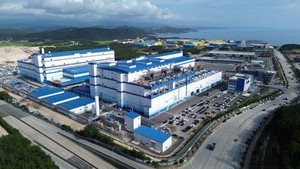
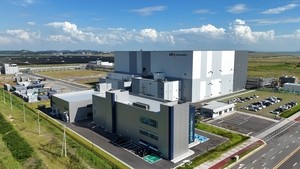
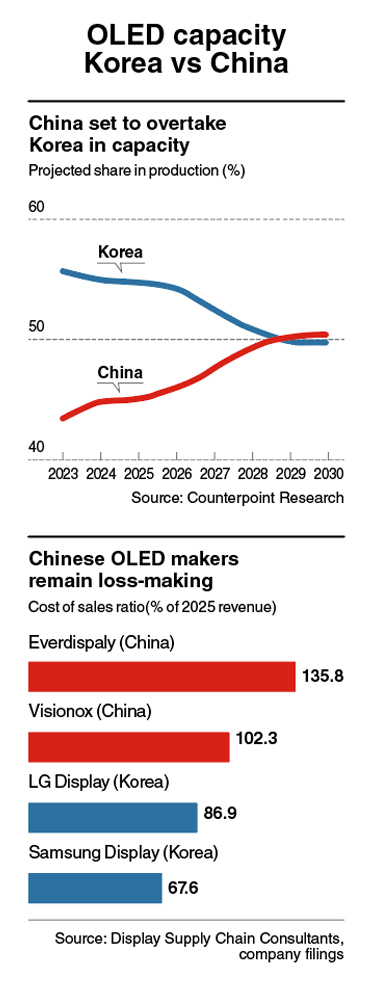
China is poised to overtake South Korea in OLED production capacity by 2029, raising fresh concerns that the industry could gradually shift toward price-driven competition — echoing the trajectory of the LCD market.
According to industry tracker Counterpoint Research, Chinese panel makers are rapidly expanding investments in next-generation production lines, including 8.7-generation fabs, narrowing the gap with Korean rivals faster than expected.
Lee Jae-ho, a senior analyst at Counterpoint Research, warned that Korea’s more cautious expansion strategy could become a structural disadvantage over time.
“Korea holds strong capacity across mobile, IT and TV segments, but expansion investments remain relatively conservative compared to China,” Lee said. “As seen in the LCD market, if China continues to scale up aggressively, technological advantages alone may not be enough to sustain leadership.”
Capacity vs competitiveness
The projection has reignited debate over whether sheer production capacity can translate into real competitiveness in the OLED market.
In the display industry, scale has historically played a decisive role in pricing power. As supply expands, panel prices tend to decline, often reshaping market share dynamics — a pattern that underpinned China’s dominance in LCD.
Still, industry insiders caution that OLED operates under a different set of rules.
“Capacity expansion alone does not guarantee competitiveness in OLED,” said an industry source, requesting anonymity. “What matters is whether manufacturers can deliver the level of technology and performance that global clients actually demand.”
Unlike LCD, OLED competitiveness hinges more on yield rates, process stability and the ability to meet strict customer requirements.
“China may overtake Korea in capacity, but Korea still leads in technology,” said Song Jang-kun, a professor of electronic and electrical engineering at Sungkyunkwan University.
Lessons from LCD
China’s takeover of the LCD market was not simply the result of scale, but of a structural shift that followed a slowdown in technological progress.
As performance gains became incremental and less perceptible to consumers, product differentiation faded, and competition tilted toward pricing, favoring manufacturers with the largest production capacity.
Backed by heavy government support, Chinese firms expanded aggressively, driving down prices and rapidly gaining market share, while Korean players — operating on profit-driven models — struggled to keep pace.
The shift became evident in the mid-to-late 2010s, when BOE and TCL CSOT ramped up investment in Gen 8.5 and larger fabs, reshaping the market around cost-driven competitiveness.
The experience continues to fuel concerns that OLED could follow a similar path. Still, industry experts say the comparison may be premature.
“LCD became vulnerable when technological differentiation diminished, but OLED has not reached that point,” said Park Jae-geun, a distinguished professor at Hanyang University's Department of Semiconductor Engineering.
With new applications such as foldable devices, automotive displays and AR/VR panels continuing to emerge, technological requirements are still rising — keeping competition anchored in innovation rather than price.
Profitability divide
The gap between Korea and China is also evident in profitability.
As of 2025, Samsung Display maintained a cost-of-sales ratio of 67.6 percent, while LG Display improved its ratio to 86.9 percent. In contrast, Chinese firms such as Visionox and Everdisplay posted ratios of 102.3 percent and 135.8 percent, respectively, indicating losses on every unit sold.
Industry observers said this reflects a fundamental difference in business models.
“Chinese OLED makers have expanded capacity and market share with government support, but profitability remains weak due to low pricing and high fixed costs,” said an industry source who requested anonymity. “In many cases, investments are effectively sustained by subsidies rather than internal earnings.”
As competition intensifies, industry players increasingly emphasize that technology — not volume — will determine long-term leadership.
“Even if capacity increases, the real question is whether companies are investing in technologies that customers actually need,” another industry source said. “Design flexibility and power efficiency have become critical factors.”
The importance of low power consumption is growing further in the era of artificial intelligence, where energy efficiency is becoming a decisive specification for IT devices.
Diverging investment models
These differences are reflected in how companies invest.
Chinese firms, backed by state support, can continue capital spending even while absorbing losses, enabling rapid capacity expansion.
Industry estimates suggest that a single OLED fab investment in China can run up to several trillion won, or several billion dollars, often with local governments covering a significant portion of the cost.
Korean firms, on the other hand, must rely on profits to fund investment, leading them to focus on yield improvement, process optimization and low-power technologies.
The result is two distinct paths: China expanding capacity to gain share, and Korea building technology to sustain competitiveness.
Korea’s edge still holds
Global clients, particularly US tech giant Apple, demand high standards in power efficiency, design flexibility and reliability, limiting the impact of capacity expansion alone.
Park added that gaps are likely to persist in high-end segments such as automotive displays, laptops and AR devices.
As applications expand, technological maturity and process capabilities are increasingly shaping the competitive landscape.
For now, OLED remains firmly in a technology-driven phase, unlike LCD at its peak commoditization stage.
Whether that balance shifts will depend on how China’s capacity expansion reshapes supply dynamics — and whether Korean firms can sustain their edge in process innovation and customer-driven technologies.
yeeun@heraldcorp.com