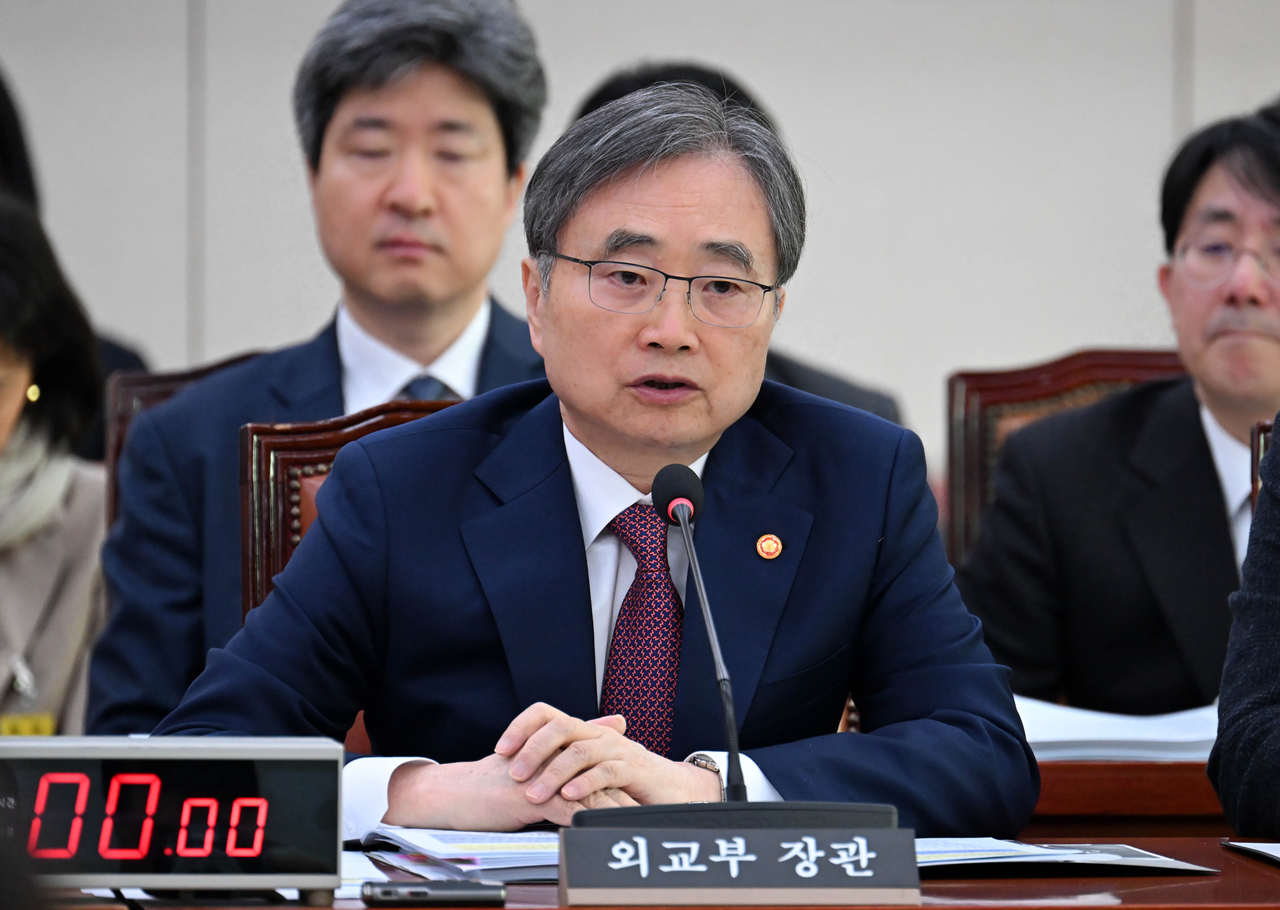
Foreign Minister Cho Hyun on Tuesday avoided a direct answer over whether Seoul had received a request from Washington to deploy a South Korean warship to the war-stricken Strait of Hormuz.
Asked by Rep. Kim Sang-wook of the ruling Democratic Party of Korea whether Seoul had received any such request from the United States, either formally or informally, Cho responded with vague remarks.
"The situation is, we can say it was a request (for naval forces deployment), or we can say it was not," Cho told the parliament during the meeting of the National Assembly's Foreign Affairs and Unification Committee.
As Democratic Party Rep. Yoon Hu-duk suspected there was a warship request because Cho hesitated to clarify instead of denying it, Cho responded, "Saying it was hard to answer does not mean there was a request (for a South Korean warship)."
Cho added, "Concerning the armed forces deployment itself, it is difficult to openly state that there was a US request or not."
Twenty-six South Korean vessels, including nine oil tankers, and over 180 crew members aboard them, remain stranded in the Strait of Hormuz, as these vessels were blocked from transiting the strait, according to a government estimate provided with Yoon.
Cho also said that legal procedures required in sending troops on overseas missions would depend on the nature of the operation. Related laws dictate that missions involving engagement require the National Assembly's approval, while noncombat missions such as escorting South Korean merchant vessels do not, according to Cho.
"This is a hypothetical situation, but I believe it could depend on the mission of the vessel being sent," he said, adding he would "abide by the law and the Constitution" in making his decision.
South Korea is among the countries that US President Donald Trump singled out in his social media post calling for naval support to secure the Strait of Hormuz, as one of the US allies affected by the Middle East conflict.
Trump doubled down on his request Sunday, calling on allies to police the strait. "Whether we get support or not, I can say this, and I said it to them: We will remember," Trump said.
"Concerning issues on the Strait of Hormuz, Seoul and Washington are closely communicating through various channels while paying attention to Trump's remarks on social media," Cho said.
The parliamentary interpellation followed Cho's phone talks with US Secretary of State Marco Rubio on Monday evening.
In the phone call upon the request from Washington, Rubio called for close cooperation between the two countries over long-term security in the Strait of Hormuz and multinational cooperation to address global economic uncertainties and tame oil prices, according to the Foreign Ministry.
Cho was quoted as saying by the Foreign Ministry that peace in the Middle East region and safe and free passage of vessels in the Strait of Hormuz was very important for South Korea's national security and economy, vowing to continue close cooperation in the future.
Cho said he was likely to hold talks with Rubio at the upcoming Group of Seven Foreign Ministers' meeting in Paris, if he attends the event.
Later in a separate parliamentary inquiry during the National Defense Committee Tuesday, Defense Minister Ahn Gyu-back said his ministry "had not received any official request" for a naval dispatch in the form of a document or a ministerial-level exchange, adding, "We do not consider a social media post an official request."
consnow@heraldcorp.com