Government-led M.AX alliance targets productivity, data integration and industrial resilience as China advances AI-led manufacturing
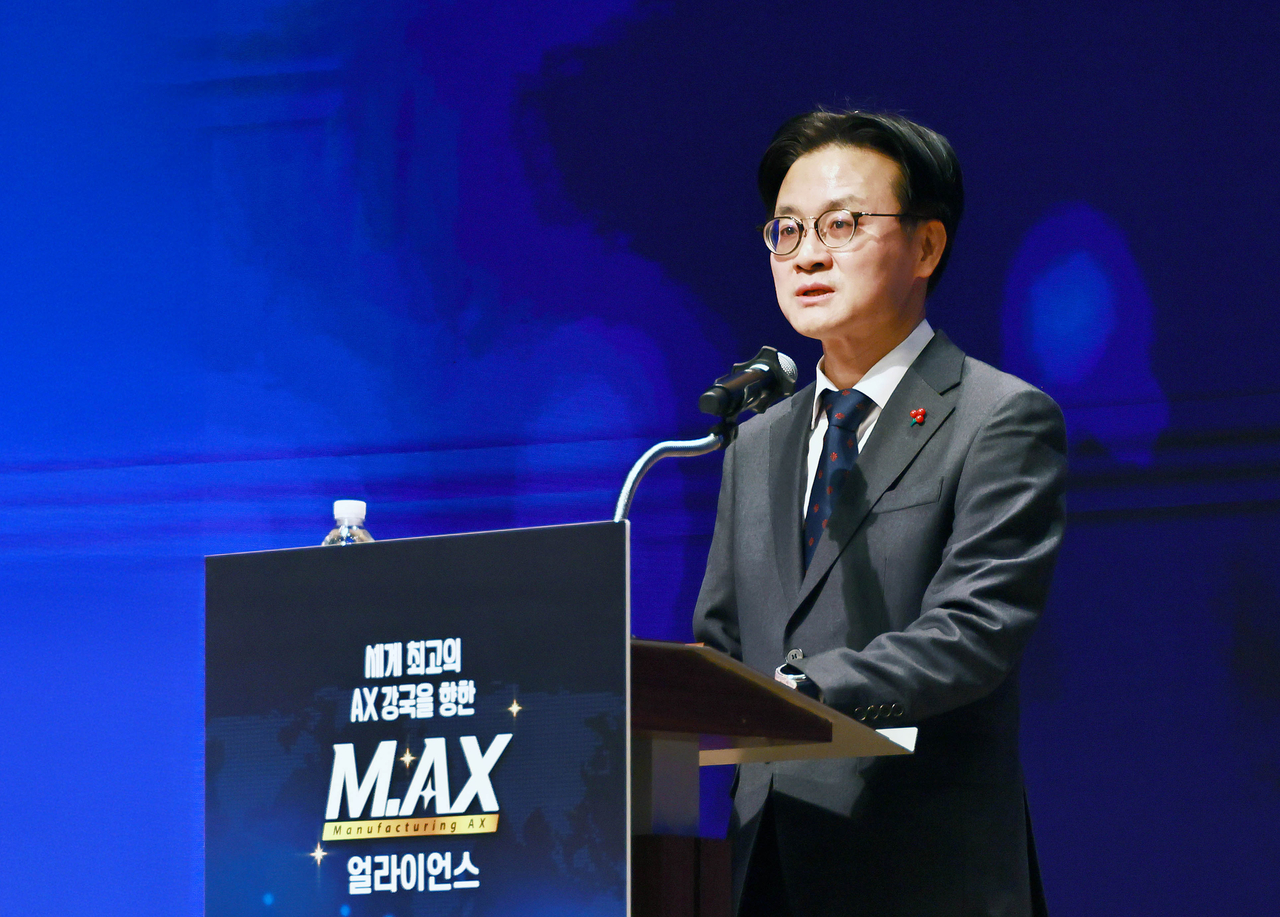
South Korea is accelerating an AI-driven overhaul of its manufacturing sector as the government warns the country is losing ground to China — and may face irreversible decline without structural reform.
“China has already moved ahead, and Korea is now in a catch-up position,” Industry Minister Kim Jung-kwan said. “If we fail to transform core manufacturing sectors such as automobiles, shipbuilding and all-solid-state batteries through AI, there is no future.”
The warning comes as industry surveys show Chinese firms are on track to overtake Korean companies across all major export industries within five years, intensifying pressure on the country’s industrial model.
In response, the government is pushing the M.AX (Manufacturing AI Transformation) Alliance, a flagship public-private initiative designed to rebuild manufacturing systems around AI, data and automation.
Marking 100 days since its launch, the Industry Ministry said the alliance has expanded to about 1,300 participants, and plans to invest 700 billion won ($481 million) in manufacturing AI next year.
Manufacturing under pressure
The urgency of Korea’s AI transition is underscored by data showing a rapid erosion of manufacturing competitiveness.
A survey conducted in October of 200 companies among Korea’s top 1,000 exporters by sales found that China has already overtaken Korea in steel, general machinery, secondary batteries, displays, and automobiles and auto parts, according to the Korea Economic Federation. Industries in which Korea still holds an edge are also expected to be surpassed within five years.
Separate data from the Korea Chamber of Commerce and Industry showed that just 32.4 percent of Korean manufacturers now consider themselves technologically ahead of Chinese rivals, down sharply from nearly 90 percent in 2010.
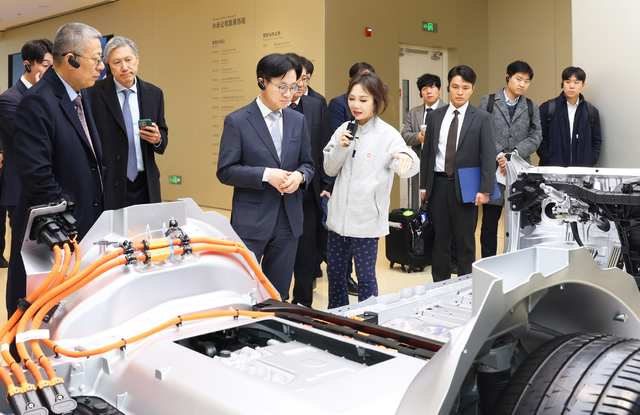
Industry Minister Kim Jung-kwan highlighted China’s rapid advances in AI-driven manufacturing as a key factor behind the widening gap. Recalling his recent visit to a Xiaomi electric vehicle factory in Beijing earlier this month, Kim described a production system built around automation and real-time data.
“The factory operated on a three-shift system and produced one electric vehicle every 76 seconds,” Kim said, noting that the facility — with an annual output of 150,000 vehicles — appeared “far more advanced” than Hyundai Motor and Kia plants in Korea.
“There is no inventory. Vehicles are delivered to customers immediately after production.”
M.AX Alliance
The M.AX Alliance is the Industry Ministry's flagship initiative to accelerate the adoption of AI across the manufacturing value chain by integrating data, production processes, factory operations, products and industrial services.
Launched in September with 1,000 large manufacturers, small and midsize firms, universities and research institutes, the M.AX Alliance aims to generate more than 100 trillion won in added value vehicles, humanoid robots and AI factories by 2030.
"Even during intense tariff negotiations in July and August, the one policy I continued to focus on was the AI transformation of manufacturing through M.AX," Industry Minister Kim has said.
From the country's top manufacturing giants, such as Samsung Electronics and Hyundai Motor Group, to small- and mid-sized manufacturers such as Rainbow Robotics and technology firms, the coalition brings together companies across 10 industrial divisions.
These cover AI factories, AI-based manufacturing services, AI-driven distribution and logistics, autonomous vehicles, humanoids, autnomous hips, AI-enabled home appliances, AI defense systems, AI bio industries and AI semiconductors.
The goal is to connect Korea's extensive-manufacturing data accumulated across decades of industrial activity with AI models developed by academia and technology firms, with the goal of improving productivity, quality and cost efficiency across industrial sectors.
Making progress
Marking the 100th day, the Industry Ministry revealed how cooperative projects are progressing with speed. The number of cumulative projects has surpassed 100, with early results showing gains in productivity, the ministry said.
At GS Caltex, AI was applied to crude oil distillation to reduce incomplete combustion, cutting fuel costs by about 20 percent. HD Hyundai Mipo deployed AI-enabled robots for welding inspections, reducing work time by 12.5 percent, while agricultural machinery maker TYM used AI to detect oil leaks, scratches and defects, improving productivity by 11 percent.
The ministry also said humanoid robots have begun to be deployed this year across manufacturing sites such as display and shipbuilding plants, as well as service settings including logistics, hospitals and hotels.
Starting with 10 projects this year, the government plans to run more than 100 demonstration projects by 2027 to collect core manufacturing data and train AI and robotic systems.
The ministry also set out five priority tasks to be pursued next year, including large-scale projects to generate, share and utilize manufacturing data; accelerating the development of sector-specific AI models; and starting development of on-device AI semiconductors. It also aims to build an export base for AI factories and expand AI transformation programs at the regional level.
"The coming year should mark a turning point for both the alliance and Korea's manufacturing sector," Kim said.
herim@heraldcorp.com