SUV-heavy lineup, rising sales, stronger margins narrow the gap with Japanese rival
Toyota has set the pace in the US hybrid market for decades. The Prius defined the segment, while hybrid SUVs such as the RAV4 and Highlander entrenched Toyota’s dominance as American consumers gravitated toward larger vehicles.
What once looked like an overly cautious strategy — prioritizing hybrids while rivals bet heavily on full electric vehicles — is now paying dividends. As US EV demand cools and subsidies fade, hybrids have reemerged as the most commercially resilient powertrain.
That shift has opened a strategic window for Hyundai Motor Group.
Once seen as a fast follower in hybrids, Hyundai is moving to challenge Toyota, using a combination of scale, product breadth and improving technology — particularly in sport utility vehicles.
Hybrids fuel Hyundai’s US growth
Hyundai Motor Company and Kia’s US sales rose 8.1 percent year-on-year to 1.67 million units from January to November despite tariff headwinds, putting the group on track to surpass last year’s total and mark its strongest US performance in more than a decade.
Hybrids are doing the heavy lifting.
Hybrid sales surged 48.3 percent to 293,512 units over the same period, accounting for more than 20 percent of Hyundai and Kia’s US sales — a critical threshold that signals hybrids are no longer a niche offering but a core pillar of the group’s US strategy.
Momentum has been strongest in SUVs. Hyundai’s Palisade Hybrid gained early traction, while Kia’s Sportage Hybrid and Niro Hybrid posted triple- and double-digit growth rates, underscoring rising consumer appetite for fuel-efficient SUVs rather than sedans or full EVs.
Industry watchers say the pace of Hyundai’s gains is notable given that the group faced a 25 percent US auto tariff until recently, compared with Toyota’s 15 percent.
Hyundai takes on Toyota
Toyota is still expected to retain the No. 1 spot in US hybrid sales. But Hyundai’s trajectory suggests it is emerging as the only credible challenger.
“US automakers have a relatively limited hybrid lineup, lagging behind Toyota,” said Kim Pil-su, a car engineering professor at Daelim University. “Hyundai Motor Group is the only brand that comes close to matching Toyota’s technological sophistication and fuel efficiency.”
The gap has narrowed as Hyundai rapidly expanded its hybrid lineup in mass-market SUVs, where US demand is strongest, while achieving economies of scale that support competitive pricing even without generous subsidies. Hybrids also offer a structural profit advantage over EVs, where battery costs and supplier negotiations continue to compress margins.
“In the current US market, hybrids — especially SUVs — offer stronger demand and less pricing volatility than EVs,” said an industry source. “They allow automakers like Hyundai to retain more margin.”
Next battlefield: luxury hybrids
Where Toyota still holds a decisive edge is in luxury hybrids, led by Lexus.
Hybrid versions of the Lexus RX and NX have been instrumental in driving Toyota’s hybrid volumes, particularly among US consumers seeking premium comfort without EV range anxiety or charging concerns.
Hyundai now appears determined to replicate that playbook.
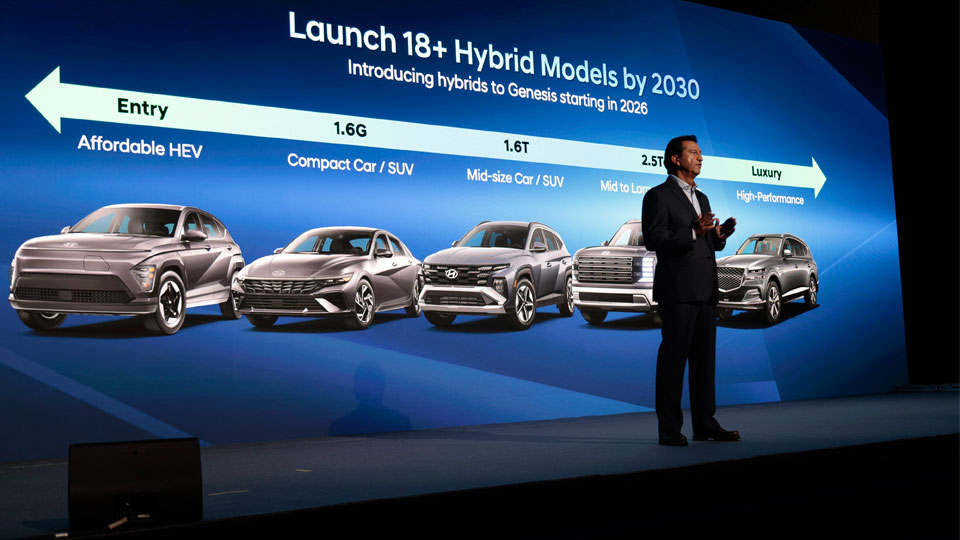
The automaker plans to add hybrid variants to the Genesis GV70, GV80 and G80, with development slated for completion in late 2026 and market launches expected by 2027. The move is part of a broader plan to expand Hyundai Motor Group’s hybrid lineup to more than 18 models by 2030.
“A stronger hybrid presence at the luxury level would reinforce Hyundai’s overall hybrid positioning,” Kim said. “That’s where Toyota, via Lexus, has been especially effective.”
hyejin2@heraldcorp.com