
Free trade language hangs in balance as members face protectionist headwinds
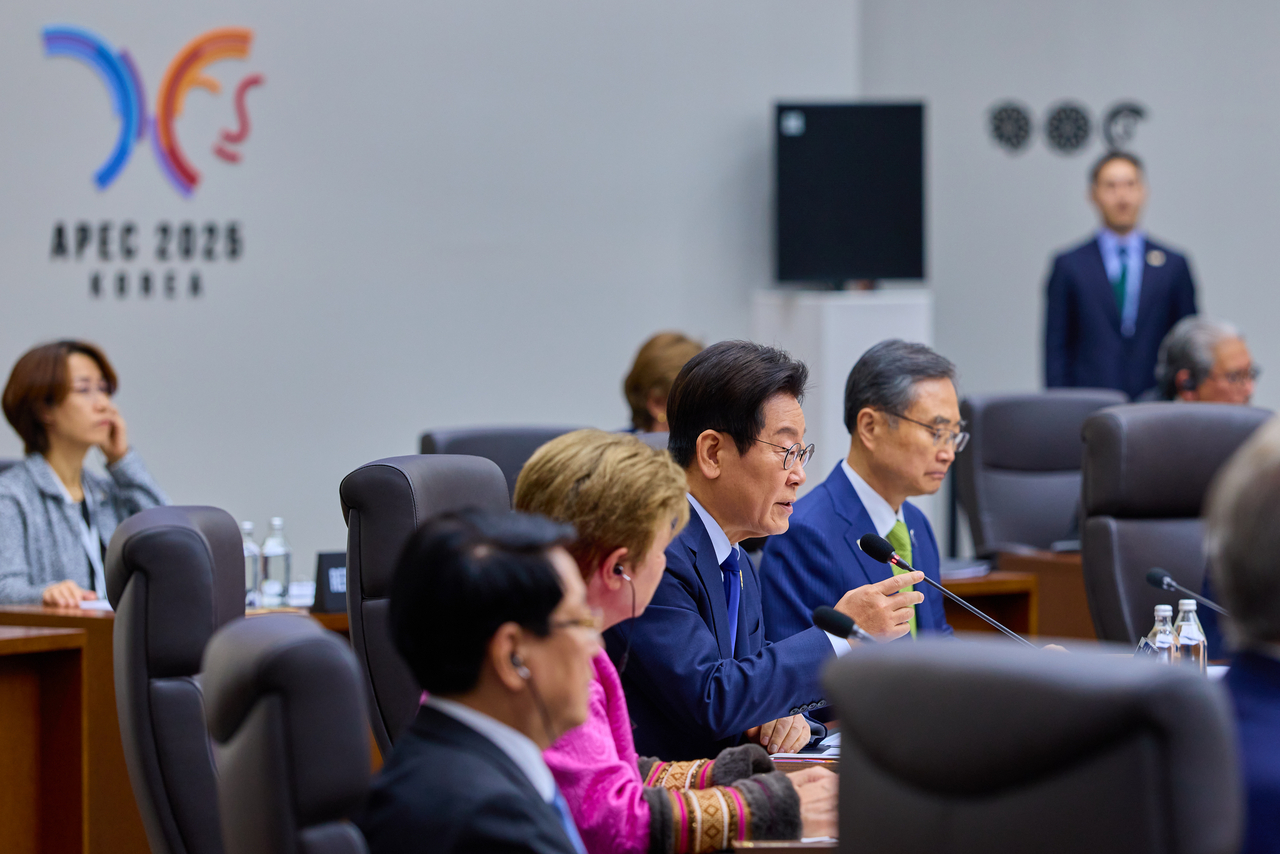
As global leaders gather in the South Korean historic city of Gyeongju for the 2025 Asia-Pacific Economic Cooperation summit, all eyes are on whether the forum’s 21 member economies will be able to make a joint declaration this year.
South Korea’s Foreign Minister Cho Hyun said Thursday that the members were “very close” to finalizing the declaration, which would cap two days of summit-level discussions on Friday and Saturday.
As the chair and host of this year’s APEC meetings, Seoul has pushed for a unified statement that highlights the region’s commitment to open markets and cooperation amid an increasingly fragmented global economy.
“It would be premature for me to make any definitive comments at this stage, since member economies are still engaged in last-minute negotiations,” Cho said during a press conference following the APEC Ministerial Meeting in Gyeongju.
A senior South Korean diplomatic source, declining to be named, said despite challenging negotiations, “it is highly likely that this year’s APEC summit will yield a Gyeongju Declaration.”
Traditionally, APEC summit declarations have underscored the importance of free and open trade — a hallmark phrase representing the forum’s commitment to economic liberalization and multilateralism since its founding in 1989.
But this year, that language faces renewed uncertainty. With the start of US President Donald Trump’s second term in January and his administration’s strong protectionist stance, some observers say the phrase “support for free trade” could be excluded from the final document.
If omitted, analysts warn, the Gyeongju APEC summit could become a symbolic turning point — one that reflects the erosion of the multilateral trade order rather than its reaffirmation.
One of the “unresolved issues” cited by Minister Cho also centers on Washington’s push for protectionist trade policies, as the Trump administration continues to ignite tariff disputes with key partners. Such tensions have made it difficult for APEC members to achieve the unanimity required for a joint declaration, observers point out.
Experts remain split over whether the Gyeongju summit can overcome these ideological divides.
Kim Tae-hwang, professor of international trade at Myongji University, said the US' protectionist line “directly conflicts with APEC’s key values of freedom and openness.”
“Although APEC declarations are nonbinding, there is a real possibility that even a symbolic statement of multilateral cooperation may not be issued,” he said, recalling that APEC summits in 2018 and 2019 — both under Trump’s first term — ended without a joint communique.
Others, however, are more optimistic. Nam Sung-wook, professor at Sookmyung Women’s University and former head of the Institute for National Security Strategy, said South Korea’s role as host could prove decisive.
“I think a declaration will be adopted, mainly because South Korea, as the chair, has a responsibility to bring the discussions to a conclusion,” Nam said Friday. “The key issue will be how the wording strikes a balance between free trade and protectionism — that will be the central focus.”
Nam added that the so-called “Gyeongju Declaration” would serve as a guiding document for the international community’s direction of cooperation and dialogue.
“Ultimately, the keyword is trade,” he said. “Trade allows countries to benefit mutually, but perspectives differ — nations with trade deficits, like the US, grow cautious about openness, while surplus economies, like China, favor freer trade. The final text will need to capture that delicate balance.”
mkjung@heraldcorp.com