Embassy's Sawasdee Seoul Festival to promote Thai pop, food, traditional martial arts, wellness on Sept. 6-7
As global supply chains shift and competition intensifies across Asia, Thailand is positioning itself as a strategic hub for trade, investment and innovation — and it wants Korean companies on board.
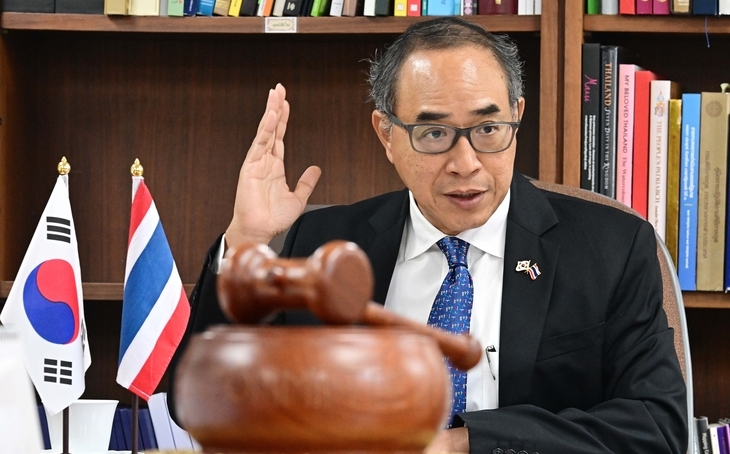
“Cooperation among economies is more critical than ever,” Thai Ambassador to Korea Tanee Sangrat told The Korea Herald, emphasizing Thailand’s ambition to become a linchpin in both regional and global supply networks.
Thailand, Southeast Asia’s largest mainland economy, has long leveraged its strategic location, advanced infrastructure and diversified industrial base to attract foreign investment. With its strong electronics sector and incentives for high-tech manufacturing, the country is increasingly marketing itself as a springboard for Korean businesses seeking access to regional markets such as Vietnam, Malaysia and Australia under the Association of Southeast Asian Nations free trade framework.
Sangrat noted that talks on the Thailand-South Korea Economic Partnership Agreement are making steady progress, with an agreement expected at the upcoming Asia-Pacific Economic Cooperation summit in October, hosted by South Korea.
“EPA is a gateway for strategic industries such as semiconductors and batteries, while also enhancing market access for auto parts, EVs and electronics,” he said.
According to the ambassador, as the APEC chair Korea will play a pivotal role in advancing regional cooperation, trade facilitation and innovation. He highlighted new opportunities in digital skills, artificial intelligence and the Bio-Circular-Green economy — Thailand’s flagship development model that integrates biotechnology, sustainable industries and green growth.
Thailand is also pushing forward with major infrastructure projects, including the Eastern Economic Corridor and Land Bridge Project, both designed to enhance regional connectivity. Here, Sangrat sees a natural role for Korean expertise.
“South Korea’s proven ability to deliver reliable infrastructure and logistics technologies will play a vital role in maximizing regional connectivity,” he said.
The ambassador pointed to Thailand’s recent trade diplomacy efforts, including a free trade agreement signed with Sri Lanka in 2024, as well as ongoing negotiations with the European Union, South Korea, Canada and the United Arab Emirates. As ASEAN’s largest automotive hub and the world’s 10th-largest auto producer — including a growing electric vehicle sector — Thailand is keen to secure its place in future supply chains.

“Thailand stands as one of the main recipients of investment moving out of China and other countries,” Sangrat said. “It is an ideal gateway and investment destination that offers lower risk for Korean investors.”
Bilateral trade between Thailand and Korea reached $15.3 billion in 2024, with Thailand exporting refined petroleum, wood products, sugar, integrated circuits and aluminum. Despite this, Sangrat contends that current engagement remains “far below potential,” given Thailand’s strategic advantages.
To close that gap, the Thai Embassy in Seoul will partner with Herald Media Group in November to host a major business forum in Bangkok. The event follows the momentum of the successful IGNITE Thailand-Korea Business Forum, co-hosted with the Industrial Estate Authority of Thailand, which brought together government agencies, major corporations and investors from both countries.
“The outcomes have been impressive. Several companies, including Enerth, KLES and Taelim Industrial, have already announced plans to invest in Thailand,” the ambassador said.
The upcoming forum in Bangkok aims to further strengthen Thailand’s position as a prime destination for trade and investment, while reinforcing its role as a bridge between Korea and the wider ASEAN market.

Festival to promote Thai soft power
But for Sangrat, Thailand’s engagement with Korea is not only about trade and infrastructure. The embassy in Seoul also follows a “3P” strategy: economic promotion, consular protection and soft power.
That soft power will be on full display at the upcoming Sawasdee Seoul Thai Festival, set for Sept. 6-7 at Cheonggye Plaza. Now in its 10th year, the event is expected to attract 60,000 visitors with a lively program of Thai pop and K-pop performances, Thai cuisine, traditional parades and wellness experiences.
“The Thai festival is a reflection of Thai (and) Korean people’s ties,” Sangrat said. Despite space constraints along the Cheonggyecheon canal, the festival has steadily expanded, doubling kiosks, restaurants and company participation compared to previous years.
Highlights include a taekwondo and Muay Thai showcase led by Thai fighter Buakaw, a parade of over 100 dancers from across Korea, free massage services offered by the Volunteer Thai Massage Association and cross-cultural collaborations between Thai and Korean artists, spanning music, drama and digital content.
“We celebrate not only Thailand, but also our host country, Korea. We want to give back and foster mutual cultural exchange,” Sangrat said.
The ambassador emphasized that the main audience is the Korean public and the international community, adding, “For the 20th anniversary, we hope to surpass 100,000 participants.”
sanjaykumar@heraldcorp.com