
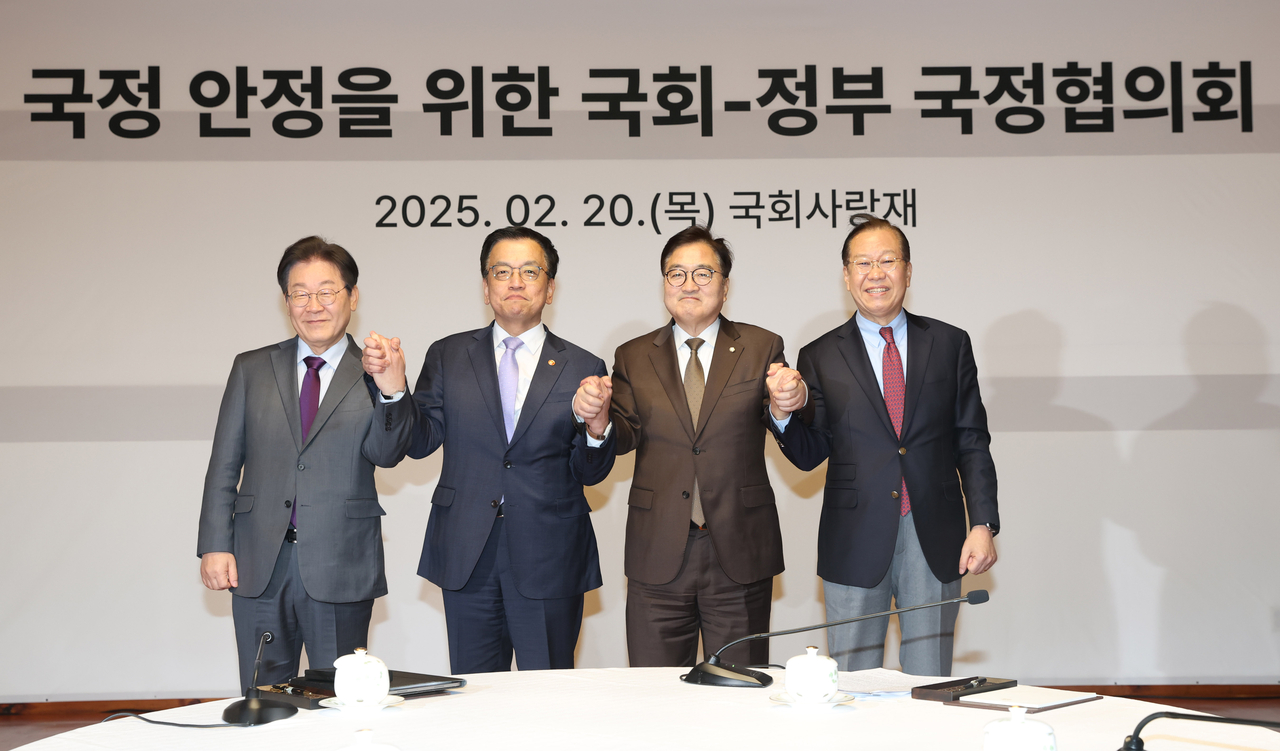
The government and rival political parties held four-way talks Thursday to discuss a special law on semiconductors, an extra budget and other pending issues.
The meeting involved acting President Choi Sang-mok, National Assembly Speaker Woo Won-shik, ruling People Power Party (PPP) interim leader Kwon Young-se and main opposition Democratic Party (DP) leader Lee Jae-myung.
The PPP and the DP have been at odds over several issues, including pension reform, a supplementary budget and a special law that seeks to exempt semiconductor workers from South Korea's 52-hour workweek system.
Choi said in his opening remarks that there is "no time to lose" over the special semiconductor law as chip workers in major economies, such as the United States and Japan, are already dedicating themselves to developing new technologies without working hour restrictions, while the US is planning to impose tariffs on chips.
The Semiconductor Special Act failed to pass last year as opposition parties disagreed with providing exemptions to the 52-hour workweek system. Currently, the country's workweek system limits employees to 40 regular hours and 12 hours of overtime per week.
"Under the current working hour system, it's difficult to do concentrated work, leading to interruptions in research and making it difficult to respond immediately to companies' orders," Choi said. "This is why enacting the Semiconductor Special Act is absolutely necessary."
Meanwhile, the DP has called on the PPP and the government to come up with an extra budget to revive the economy and improve people's livelihood.
On pension reform, the rival parties have agreed on the need to raise the premium rate from 9 percent to 13 percent but remain divided on the income replacement rate, or pension as a percentage of a subscriber's average income over their lifetime.
A DP official told Yonhap News Agency the DP will not make concessions on the semiconductor act and the pension reform, adding that no meaningful results will come from Thursday's meeting.
A PPP official also said the chances of achieving any results from the talks are "slim" unless the DP takes a more cooperative stance. (Yonhap)


![[World Class] HUFS bets on Songdo, AI to redefine what a global university can do](https://wimg.heraldcorp.com/news/cms/2026/10/18/news-p.v1.20260930.7e4dbeacfc1d4d16848c0e2a441c04e6_R.jpg?type=h&h=120)
